
Blog schedules checklists
ADHD Cleaning Planner: A Free Printable That Bends
You found the perfect planner. You filled in the first week in three colors of pen, with a highlighter system and everything. By the second Thursday it was under a pile of mail, quietly judging you. That is not a you problem. Most cleaning planners are built for a week where nothing goes wrong.
Quick answer
An ADHD cleaning planner works when it bends instead of breaking. Give it a 5 minute daily reset, one zone per cleaning day, a one-task minimum for hard days, and room for missed days. Keep it to one page and put it where you will see it. The free schedule maker builds and prints one from five questions.
Key takeaways
- A planner that survives real life has five parts: a daily reset, one zone a day, a hard-day minimum, an overflow spot and a short monthly list.
- Write tasks small enough to start: "wipe the stovetop", not "clean the kitchen".
- Plan fewer days and fewer minutes than you think. You can always do more.
- Missed days do not roll forward. Skip, then do the next zone.
- Put the page where your eyes already go, like the fridge or the inside of a cupboard door.
Why do most cleaning planners stop working?
Most planners assume a steady week with every box ticked. Miss Tuesday and Wednesday inherits Tuesday's jobs. Miss Wednesday too and the page becomes a list of debts, and nobody wants to open a list of debts.
With ADHD, that slide is easy to recognize. NIMH lists frequent trouble organizing tasks and activities, managing time and meeting deadlines, and forgetting daily activities such as chores and errands among the signs of inattention. CHADD calls getting and staying organized "a real challenge" for people with ADHD, and says many adults have trouble with clutter at home and feel overwhelmed or stuck.
So a planner that helps has two jobs: remember for you, and survive the days you do not follow it. Our ADHD cleaning schedule guide goes deeper on tying tasks to things you already do.
What does an ADHD cleaning planner need?
Five parts, and each one earns its spot on the page.
| Part | What it looks like | Why it helps | Time |
|---|---|---|---|
| Daily reset | Dishes, 5 things back, wipe the counter | Keeps the home from sliding between cleaning days | About 5 minutes |
| One zone a day | Kitchen on Monday, bathroom on Wednesday | No room switching, no "where do I start" | 10 to 20 minutes |
| Hard-day minimum | One small task for each cleaning day | Gives a low day a finish line you can reach | 1 to 3 minutes |
| Overflow spot | An "every other week" list | Tasks that did not fit are parked, not lost | Optional |
| Monthly list | One deeper job a week | Stops the big jobs from quietly piling up | 5 to 15 minutes |
The hard-day minimum is the part most planners leave out, and the one that matters most in a rough week. "Clean the bathroom" is a wall. "Wipe the mirror" is a step, and on some days the step still counts as done.
The overflow spot matters too. Without one, a task that does not fit has nowhere to go, so it crowds the next day. With one, it waits politely for a spare ten minutes. Seasonal jobs, like swapping summer bedding for warm blankets, go on the monthly list; our fall cleaning checklist splits those into short sprints.
What does a sample week look like?
Here is what the free schedule maker gave us for its starting answers: a one-bedroom home with a kitchen, living room and laundry, four cleaning days, 15 minutes a day, "up and down" energy, and nobody else helping. It trims the minutes a little for up and down energy, so each day lands at about 13.
| Day | Main zone | Tasks | Hard-day minimum |
|---|---|---|---|
| Monday | Kitchen | Counters and stovetop, sink and tap, trash and recycling out, fresh bathroom towels | Swap in fresh towels |
| Wednesday | Bathroom | Toilet, sink and counter, mirror, clear the nightstand | Clean the mirror |
| Friday | Laundry and bedroom | Start a load, change the sheets, empty the bathroom trash | Empty the trash |
| Saturday | Living room | Move the laundry along, clear every surface, dust the TV stand | Move the load to the dryer or rack |
| Any day | Daily reset | Dishes, 5 things back, wipe the counter, trash if full | The first one, or none |
Tuesday, Thursday and Sunday are rest days. Notice the small crossovers, like fresh towels on kitchen day: when a zone does not fit, the tool slides a short task onto the next cleaning day with room. Everything else goes on the every-other-week list (vacuuming, folding a load, clearing old food out of the fridge), and the monthly list gets one deeper job a week, like wiping inside the microwave.
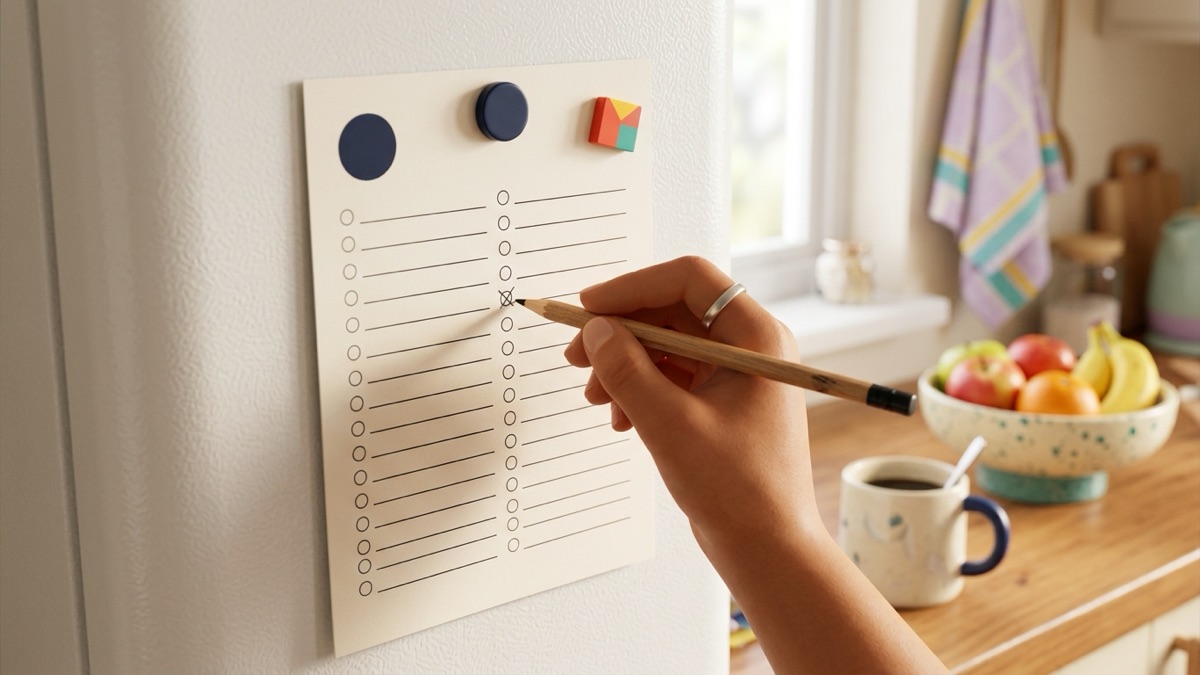
How do you fill in an ADHD cleaning planner?
Tool or blank paper, fill it in this order. The order matters more than the pen colors.
Step 1: Count your real minutes
Not your best-week minutes. Your ordinary Tuesday minutes, often just 10 or 15. Ten minutes on four days is a real schedule, and 40 minutes more than a planner in a drawer.
Step 2: Pick fewer cleaning days than you think
Three days you keep beat six days you skip. The rest are rest days. For a ready-made week to copy, the printable weekly cleaning schedule has versions for 3, 5 and 7 days.
Step 3: Give each zone a home day
List your areas (kitchen, bathroom, bedroom, living room, laundry, entryway) and give each one a day. If you have more areas than days, pair a small one with a bigger one, like entryway with laundry.
Step 4: Write tasks small enough to start
CHADD's advice on to-do lists uses a cleaning example: "clean the kitchen" is so broad you might ignore it, so break it into separate steps, such as emptying the dishwasher, wiping the counters, throwing out expired food and sweeping. Each step gets its own line and its own box. Our ADHD cleaning checklist has tiny tasks for every room if you want to borrow some.
Step 5: Circle the hard-day minimum
For each cleaning day, circle the smallest task. That is the whole job on a bad day. Doing only the circled task is following the plan, not failing it.
Step 6: Leave blank space
An empty line for overflow or a free catch-up day. Blank space is where missed days land softly.
How does the free schedule maker build your planner?
The cleaning schedule maker asks five questions:
- Your home: bedrooms, bathrooms, and extras like a laundry, entryway, desk or pets.
- Your energy, most weeks: mostly low, up and down, or pretty steady. Mostly low gives you fewer, shorter tasks, never more than four a day.
- Days you can clean: tap the days. The others become rest days.
- Minutes on a cleaning day: 5, 10, 15, 20 or 30.
- Who else helps: just you, a partner or roommate, kids, or both. With a partner it splits each day's tasks between you by minutes, and it tags the tasks kids can usually help with.
You get one page: the daily reset, a monthly list, a card for each cleaning day with tasks and minutes, a "Hard day?" line naming the one task to do (unless you chose steady energy), and the every-other-week list. Print or save PDF fits it on one A4 or Letter page. Copy checklist gives you a plain-text version for a notes app. Your answers stay in your browser, and nothing is uploaded.
Try it
Build your planner in the cleaning schedule maker, print it, and stick it on the fridge. Then run your first zone as a short sprint with the cleaning sprint timer.
Where should an ADHD cleaning planner live?
Where you already look. CHADD's tips for day planners include keeping the planner in one safe place when you are not carrying it, holding a daily planning session at a set time, and checking it at least three times a day: in the morning, around midday and in the evening.
A cleaning planner can be much lighter than that. Tape it to the fridge or inside the cupboard you open every morning. A one-minute look while the kettle boils tells you which zone is up. If you live on your phone, paste the copied checklist into a note and pin it.

What happens when you miss a day?
You skip it. That is the whole rule. Missed tasks do not roll forward, so Tuesday's jobs never pile onto Wednesday. The next cleaning day has its own zone, and that is the only thing on the list.
If a whole week slips, and weeks do slip, restart with the daily reset alone for a day or two, then pick up the next zone. No catching up, no starting the month over. The realistic cleaning schedule guide has more on restarting after a missed week.
Tip
If one task gets skipped three weeks running, the task is the problem, not you. CHADD suggests asking whether an item is too big and breaking it into smaller steps, or promising yourself a small reward for the ones you dread.
The 10 minute version
No time to build the full planner? Here is one you can set up in about 10 minutes with a sheet of paper and a pen.
| Minutes | Do this | You end up with |
|---|---|---|
| 0 to 2 | Write 3 cleaning days across the top | A week with rest built in |
| 2 to 5 | Give each day one zone | No more "where do I start" |
| 5 to 8 | Under each zone, write 3 tiny tasks | A list you can actually finish |
| 8 to 9 | Circle the smallest task each day | Your hard-day minimum |
| 9 to 10 | Write "Daily reset: dishes, 5 things back" at the bottom | A floor for every day |
Heads up
If your planner includes the bathroom, use one cleaner at a time, open a window or run the fan, and follow the label. Never mix bleach with ammonia (found in many glass cleaners), vinegar or other acids, because the mix can release gases that are dangerous to breathe.
A planner that forgives you
A good ADHD cleaning planner is small, visible and forgiving: one zone a day, a five minute reset, one tiny task for hard days, and a place for everything that did not fit. It is a cleaning tool, and that is all it needs to be. If ADHD, or something that feels like it, makes daily life hard across the board, a health care provider or mental health professional can help. The TidySprint app, coming soon, will turn each day's zone into tiny tasks and a short sprint with Zip.
Until then, print the page, stick it where you look, and let the paper do the remembering. You only ever have to do today's box, and some days the box is one mirror.
TidySprint guides share practical cleaning and routine ideas. They are not medical advice, diagnosis or treatment. If ADHD, depression or anything else is making daily life hard, please talk to a clinician. Using a strong cleaner? Open a window, follow the label, and never mix bleach with ammonia, vinegar or other cleaners.
Questions people ask
What should an ADHD cleaning planner include?
Five parts: a 5 minute daily reset, one zone for each cleaning day, a one-task minimum for hard days, a spot for tasks that did not fit, and a short monthly list. Anything more tends to end up in a drawer.
Is there a free ADHD cleaning planner PDF?
Yes. The free TidySprint cleaning schedule maker builds a planner from five questions. Press Print or save PDF, then choose Save as PDF in your browser's print window to keep a copy on your phone or computer.
What should I do when I miss a day on my cleaning planner?
Skip it and do the next zone on the page. Missed tasks do not roll forward into a bigger pile. If a whole week slips, restart with the daily reset for a day or two, then carry on.
Is a paper planner or an app better for ADHD cleaning?
Whichever you will actually look at. CHADD suggests experimenting with formats and keeping your planner in one place you always check. Many people like a printed page on the fridge because it is visible without opening anything.
How many minutes a day should an ADHD cleaning planner ask for?
Start small, often 10 to 15 minutes on three or four days, plus an optional 5 minute reset. A plan you keep beats a plan that looks impressive, and you can add minutes once the small version feels easy.
Where these facts come from
- NIMH: Attention-Deficit/Hyperactivity Disorder, What You Need to Know: www.nimh.nih.gov/health/publications/attention-deficit-hyperactivity-disorder-wh
- NIMH: ADHD in Adults, 4 Things to Know: www.nimh.nih.gov/health/publications/adhd-what-you-need-to-know
- CHADD: Organizing the Home and Office Space: chadd.org/for-adults/organizing-the-home-and-office-space/
- CHADD: Time Management and ADHD, Day Planners: chadd.org/for-adults/time-management-planner/
- CHADD: Time Management and ADHD, To-Do Lists: chadd.org/for-adults/time-management-and-adhd-to-do-lists/
- CDC: Cleaning and Disinfecting with Bleach: www.cdc.gov/hygiene/about/cleaning-and-disinfecting-with-bleach.html
- Poison Control: Chlorine gas: www.poison.org/articles/chlorine-gas
Read next
schedules checklists
A Realistic Cleaning Schedule for Any Kind of Week

schedules checklists
Printable ADHD Cleaning Checklist, Room by Room (Free)
schedules checklists
ADHD Cleaning Schedule: Daily, Weekly and Monthly