
Blog schedules checklists
Bathroom Cleaning Checklist: Quick, Weekly and Deep
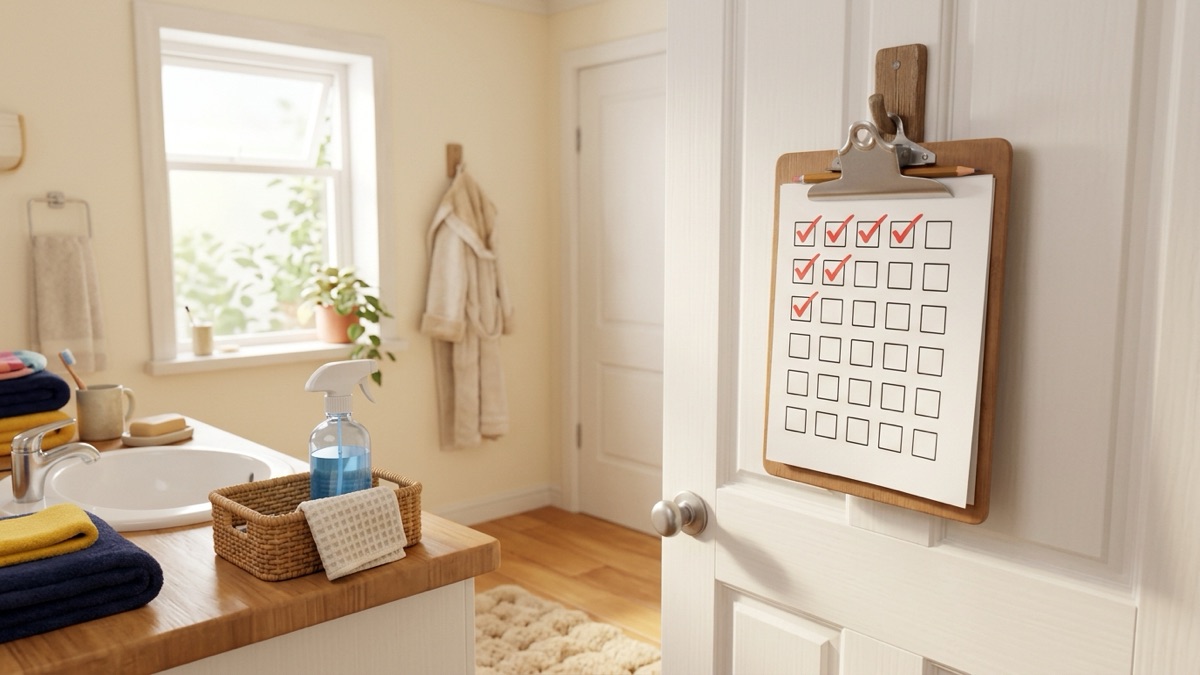
The bathroom is the room that goes from fine to "please do not look in there" the fastest. A checklist helps, but only if it is the right size for today. So here are three: a quick one, a weekly one and a deep one, each with minutes, so you can pick the one that fits the energy you actually have.
Quick answer
A bathroom cleaning checklist works best in three levels. Quick, about 10 minutes: air, counter, sink, toilet, towels, trash. Weekly, about 25 minutes: add the mirror, shower or tub, high-touch spots and the floor. Deep: one 15 minute sprint a week for grout, the shower head, behind the toilet and the fan cover.
Key takeaways
- Every list starts the same way: open a window or run the fan.
- Three lists, not one giant one. Pick by energy, not by guilt.
- One cleaner per session, never mixed with another.
- Every row has minutes, so you can stop at any line and still be done.
- Deep jobs rotate, one 15 minute sprint a week, so none of them piles up.
Before any list: air and one cleaner
Ventilation is step one on all three lists. Poison Control says to ventilate well, especially in small rooms like bathrooms, by opening a window or door and running an exhaust fan, and to never mix household cleaning products.
Then pick one cleaner for the session. A bathroom cleaner whose label lists your surfaces works, and so does warm water with a little dish soap. CDC says cleaners that contain soap or detergent remove germs and dirt, and suggests disinfecting when someone is sick or at higher risk of getting sick. If you do use a disinfectant or bleach product, follow the label, including how long the surface should stay wet.
Heads up
Never mix bleach with ammonia (in many glass cleaners), vinegar or other acids (in some toilet bowl cleaners). The mix can release gases that are dangerous to breathe, according to CDC and Poison Control. One cleaner at a time, a window open or the fan running, and follow the label. Poison Help: 1-800-222-1222.
The quick bathroom checklist (10 minutes)
For busy weekdays, a couple of times a week. This is the one that keeps the room from sliding.
| Task | Minutes | Done when |
|---|---|---|
| Open a window or turn on the fan | 0.5 | Air is moving |
| Clear the counter down to 3 things | 2 | You can see the counter |
| Wipe the sink, tap and counter | 2 | No toothpaste spots |
| Brush the toilet bowl, wipe the seat and lid | 2.5 | Lid down, flushed |
| Hang up towels or swap in a fresh one | 1 | Towels open, not bunched |
| Empty the trash | 1 | New bag in |
| Wipe the floor around the toilet | 1 | One clean patch |
Out of time at minute 5? Stop after the toilet. That is still a real clean.
The weekly bathroom checklist (about 25 minutes)
Once a week, one bathroom. The order matters: spray the shower first so the cleaner sits while you do everything else, then go top to bottom and clean to dirty, with the floor last.
| Task | Minutes | Done when |
|---|---|---|
| Open a window or turn on the fan | 0.5 | Air is moving |
| Spray the shower or tub, then leave it | 1 | Walls and tub are wet with cleaner |
| Dry-dust the light, shelves and top of the mirror | 2 | Cloth comes away gray, surfaces don't |
| Mirror: damp cloth, then a dry one | 2 | No streaks from the side |
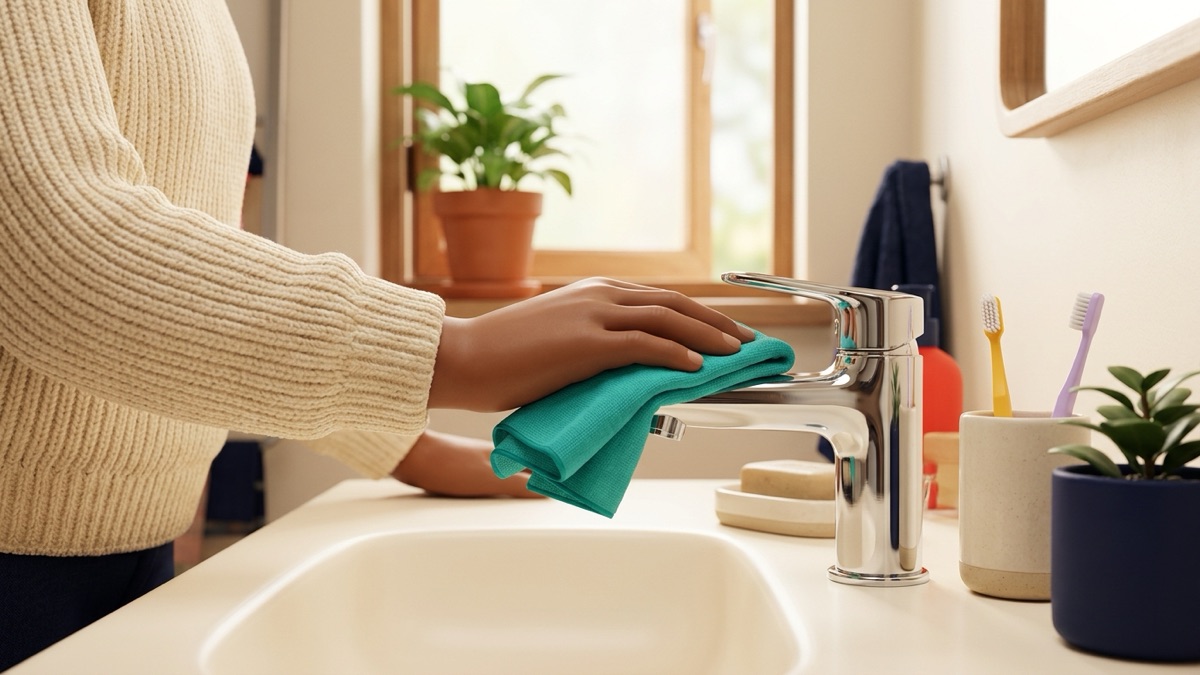
| Sink, tap and counter | 3 | Tap shines |
| Toilet: outside top down, then the bowl | 5 | Lid closed, flushed |
| Shower or tub: wipe and rinse | 5 | Walls feel smooth |
| Light switch, door handle, cabinet pulls | 1.5 | Wiped once each |
| Fresh towels, shake the bath mat | 1 | Mat back down |
| Empty the trash | 1 | New bag in |
| Sweep or vacuum, then damp-wipe the floor | 3 | Floor is dry and clear |
That is about 25 minutes. CDC lists light switches, doorknobs and countertops among the high-touch surfaces worth cleaning regularly, which is why they get their own row. For the full walk-through of this order, see how to clean a bathroom in 15 minutes.
The deep bathroom checklist (one sprint a week)
Deep jobs do not need a deep-clean day. Do one 15 minute sprint a week and the whole list comes around about once a month.
| Sprint | Tasks | Minutes | Safety note |
|---|---|---|---|
| Week 1 | Shower walls and grout lines, one wall per sprint | 15 | Window open or fan on, one cleaner only |
| Week 2 | Soak the shower head; wash or swap the shower curtain liner | 15 | Vinegar alone for the soak, never with bleach |
| Week 3 | Behind and around the toilet, the base, baseboards, cabinet fronts | 15 | Gloves, one cleaner |
| Week 4 | Wash the bath mat; wipe the fan cover; clear out old products | 15 | Switch the fan off first; check labels for disposal |
A few notes for the deep list:
- Grout and tile: our guide to cleaning tile grout covers the one-line-per-sprint method.
- Shower head: how to clean a shower head walks through the vinegar soak. Check your fixture's care guide first, since some finishes need gentler care, and remember vinegar is an acid, so it never meets bleach.
- Fan cover: switch the fan off and let it stop before you wipe the cover. For anything beyond the cover, check the fan's manual.
- Old products: EPA says leftover cleaners can contain hazardous ingredients and need special care. Read the label for disposal directions, never combine leftovers, and ask your local waste agency, since rules vary by area.
- Mold: small spots on hard surfaces can be scrubbed with detergent and water and dried completely, EPA says, with the window open or the fan running. If a patch is bigger than about 10 square feet, or came from sewage or flooding, EPA points to a professional. The deep bathroom guide covers it step by step.
How do you keep a checklist from turning into a guilt list?
A checklist should tell you what to do next, not grade you. A few ground rules:
- Pick the list first, then start. Tired? The quick list. That is the whole decision.
- Skipping a row is allowed. Nothing on these lists is urgent except airflow and never mixing products.
- Stop at any line. Every row you finish is finished.
- Short beats heroic. CHADD, the national ADHD organization, suggests breaking a complex task into smaller steps and planning sessions of 10 to 15 minutes if longer ones feel frustrating. These lists are built that way on purpose.
If focus, energy or keeping up with daily tasks feels hard across your whole life, not just the bathroom, a health care provider or mental health professional can help you figure out why.
A sample bathroom week
Here is one way to spread the three lists over a week without any day getting heavy.
| Day | List | Minutes |
|---|---|---|
| Monday | Quick checklist | 10 |
| Thursday | Quick checklist | 10 |
| Saturday | Weekly checklist | 25 |
| Sunday | One deep sprint from the rotation | 15 |
| Any day | Towel swap and trash, if you feel like it | 2 |
Your week will look different, and it should. The realistic cleaning schedule guide has versions for shift work, parenting and low-energy weeks, and the room by room ADHD cleaning checklist does the same thing for every other room.
Try it
Tell the cleaning schedule maker how many bathrooms you have and how many minutes you really have, and it puts a bathroom day in your week (plus a hard-day minimum if your energy is low or up and down). On the day, open the cleaning sprint timer and pick the bathroom: it shows one tiny task at a time in a shuffled order, so open the window or turn on the fan before you press start.
The TidySprint app, coming soon, will turn a photo of your bathroom into a short list like these and run the sprint with you.
The takeaway
You do not need one perfect bathroom routine. You need three sizes of the same list: 10 minutes when that is all you have, 25 minutes once a week, and one deep sprint that rotates. Start every one with fresh air, use one cleaner, and let any row be the last row for today.
TidySprint guides share practical cleaning and routine ideas. They are not medical advice, diagnosis or treatment. If ADHD, depression or anything else is making daily life hard, please talk to a clinician. Using a strong cleaner? Open a window, follow the label, and never mix bleach with ammonia, vinegar or other cleaners.
Questions people ask
What should be on a bathroom cleaning checklist?
Ventilation first, then the counter, sink and tap, the toilet, the mirror, the shower or tub, towels, trash and the floor. A deep checklist adds grout, the shower head, the bath mat and behind the toilet.
How often should you clean a bathroom?
There is no official rule. A useful rhythm is a 10 minute quick clean a couple of times a week, a 25 minute weekly clean, and one deep sprint a week that rotates through the monthly jobs. Shared bathrooms may need more.
How long does it take to clean a bathroom?
About 10 minutes for a quick clean and about 25 minutes for a full weekly clean of one bathroom. Deep jobs like grout or the shower head take about 15 minutes each, done as separate sprints.
What should you do first when cleaning a bathroom?
Open a window or turn on the fan, then spray the shower or tub so the cleaner can sit. After that, work from the cleanest areas to the dirtiest and do the floor last.
Is it safe to use bleach to clean a bathroom?
Only on its own, as the label directs, with a window open or the fan running. Never mix bleach with ammonia, vinegar or other acids, including some toilet bowl cleaners, because the mix can release dangerous gases.
Where these facts come from
- Poison Control: Top tips for a safe spring cleaning: www.poison.org/articles/spring-cleaning
- Poison Control: Chlorine gas: www.poison.org/articles/chlorine-gas
- CDC: When and How to Clean and Disinfect Your Home: www.cdc.gov/hygiene/about/when-and-how-to-clean-and-disinfect-your-home.html
- CDC: Cleaning and Disinfecting with Bleach: www.cdc.gov/hygiene/about/cleaning-and-disinfecting-with-bleach.html
- EPA: A Brief Guide to Mold, Moisture and Your Home: www.epa.gov/mold/brief-guide-mold-moisture-and-your-home
- EPA: Household Hazardous Waste: www.epa.gov/hw/household-hazardous-waste-hhw
- CHADD: Organizing the Home and Office Space: chadd.org/for-adults/organizing-the-home-and-office-space/
Read next
schedules checklists
A Realistic Cleaning Schedule for Any Kind of Week
schedules checklists
ADHD Cleaning Planner: A Free Printable That Bends
schedules checklists
Printable ADHD Cleaning Checklist, Room by Room (Free)
schedules checklists
ADHD Cleaning Schedule: Daily, Weekly and Monthly
schedules checklists
Fall Cleaning Checklist: A Cozy Reset in Short Sprints
schedules checklists
Cleaning Checklist Template: Room by Room, Free to Print