
Blog schedules checklists
ADHD Cleaning Schedule: Daily, Weekly and Monthly
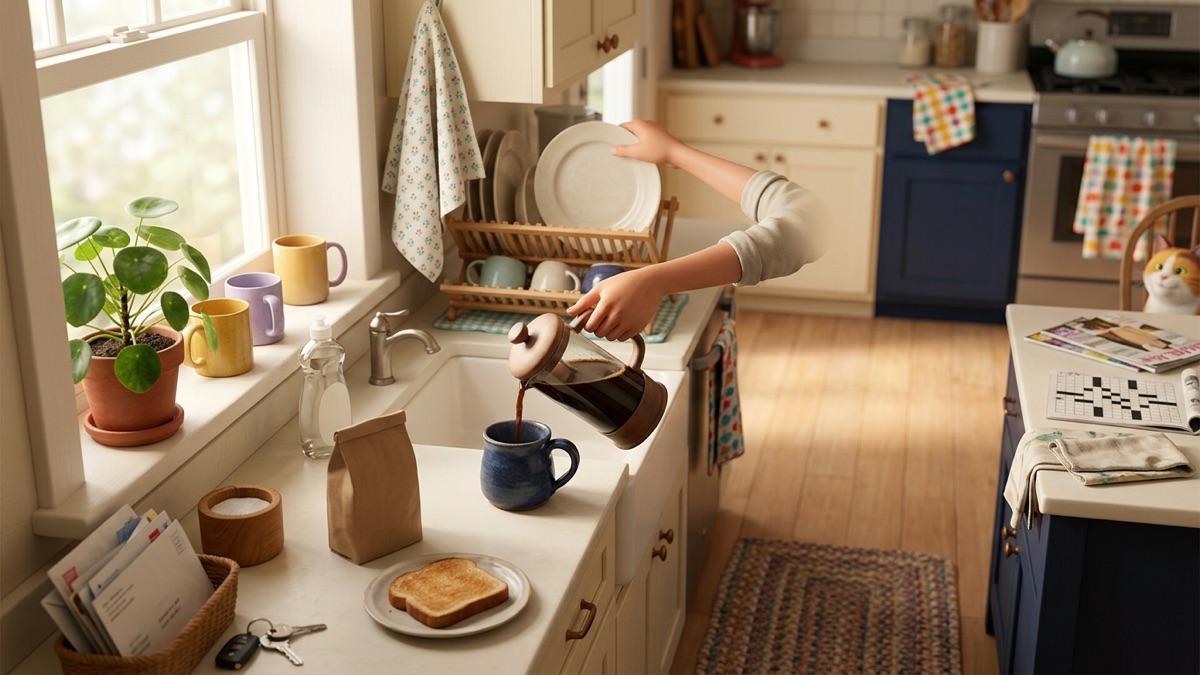
You have made a cleaning schedule before. It was color-coded, it was ambitious, and by Thursday it was a piece of paper you avoided looking at. That is not a character flaw. It usually means the schedule asked your brain for the things it finds hardest: remember, decide and start, every single day.
Quick answer
An ADHD cleaning schedule works when it does the remembering for you. Anchor each task to something you already do, clean one zone per day for 10 to 15 minutes, keep the list where you can see it, set a one-task minimum for hard days, and restart at today after a missed day, with no catching up.
Key takeaways
- Tie every task to an anchor you already do ("after I start the coffee, I empty the dish rack"), so memory is not doing the work.
- Clean one zone a day for 10 to 15 minutes instead of the whole home at once.
- Put the schedule where you cannot miss it: the fridge door, a cupboard you open daily, a labeled phone alarm.
- Every cleaning day gets a hard-day minimum, one small task that still counts.
- Missed days do not roll over. You restart at today.
Why do normal cleaning schedules fall apart with ADHD?
Most schedules assume you will remember the plan, start on cue and track time as you go. With ADHD, each of those can be the hard part. NIMH lists frequent trouble organizing tasks and activities, managing time, and forgetting daily activities such as chores and errands among the signs of inattention. CHADD, the national ADHD organization, calls getting and staying organized "a real challenge" and notes that weak organizational skills, time management and working memory problems can add up to unfinished projects at home.
So the answer is not more willpower. It is a schedule that tells you when (an anchor), what (one zone), how much (a small, fixed time) and what counts on a bad day (a minimum). If you are wondering whether ADHD is part of your story, a health care provider or mental health professional is the person to ask. This schedule works either way. For more on why cleaning can feel so hard, and what helps beyond a schedule, see our ADHD cleaning guide.
How do you anchor cleaning to things you already do?
An anchor is something you already do every day without thinking: making coffee, getting home, brushing your teeth. You attach one small task to it, in the form "after X, I do Y."
Psychologists call this kind of if-then plan an implementation intention. A research review from 2006 pooled 94 tests and found these plans had a medium to large positive effect on people reaching their goals. The review looked at goals in general, not ADHD or housework, so treat it as a promising tool, not a promise.
Anchors that tend to work well:
| After I... | I will... | Time |
|---|---|---|
| Start the coffee or kettle | Empty the dish rack or dishwasher | 3 min |
| Get home and drop my keys | Put 5 things back where they live | 2 min |
| Finish dinner | Wipe the counter and the stovetop | 3 min |
| Brush my teeth at night | Wipe the bathroom sink | 1 min |
| Change out of work clothes | Put them in the hamper or on a hook | 1 min |
Keep the anchor and the task close together, in place and in time. "After dinner, I wipe the counter" works. "After dinner, I clean the bathroom upstairs" needs a whole new start.
Why one zone a day?
Switching rooms is where cleaning often derails. You go to put a mug away, find the mail, open the mail, and 40 minutes later you are reorganizing a drawer somewhere else. A zone schedule gives each area its own day, and on that day you only look at that area.
A zone also has an edge. "Kitchen for 10 minutes" ends. "Clean the house" never does, which is exactly why it is so hard to start. If you want each zone broken into tiny steps, our room by room ADHD cleaning checklist has them.
How do you make the schedule impossible to miss?
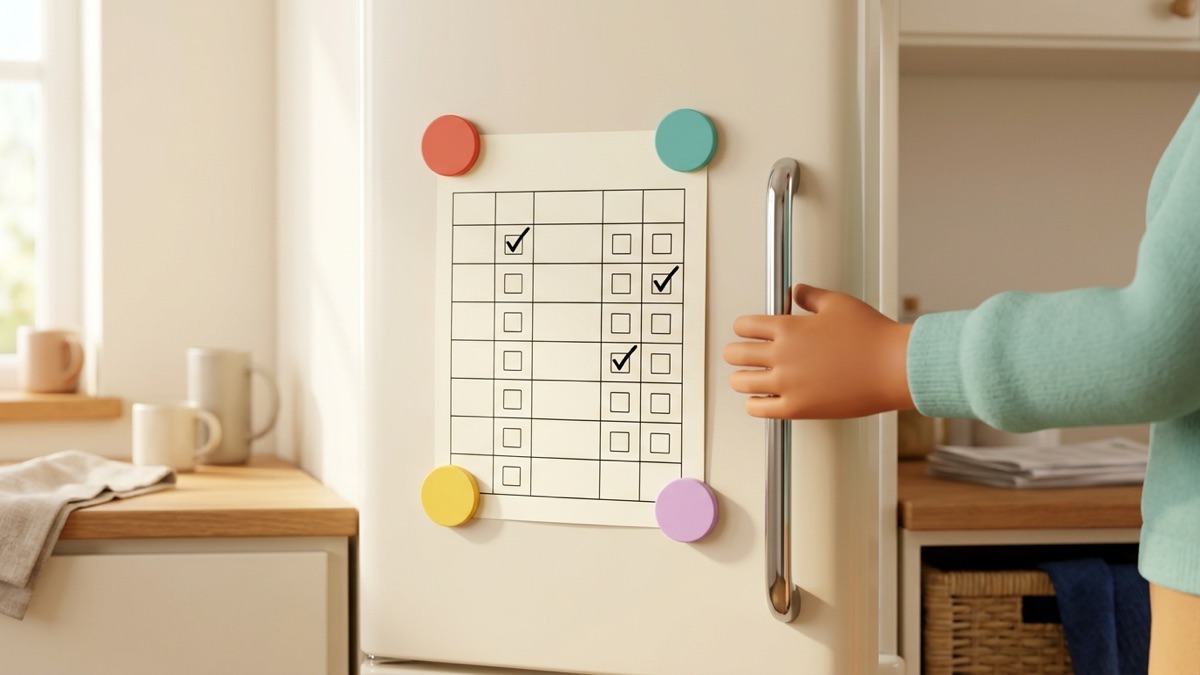
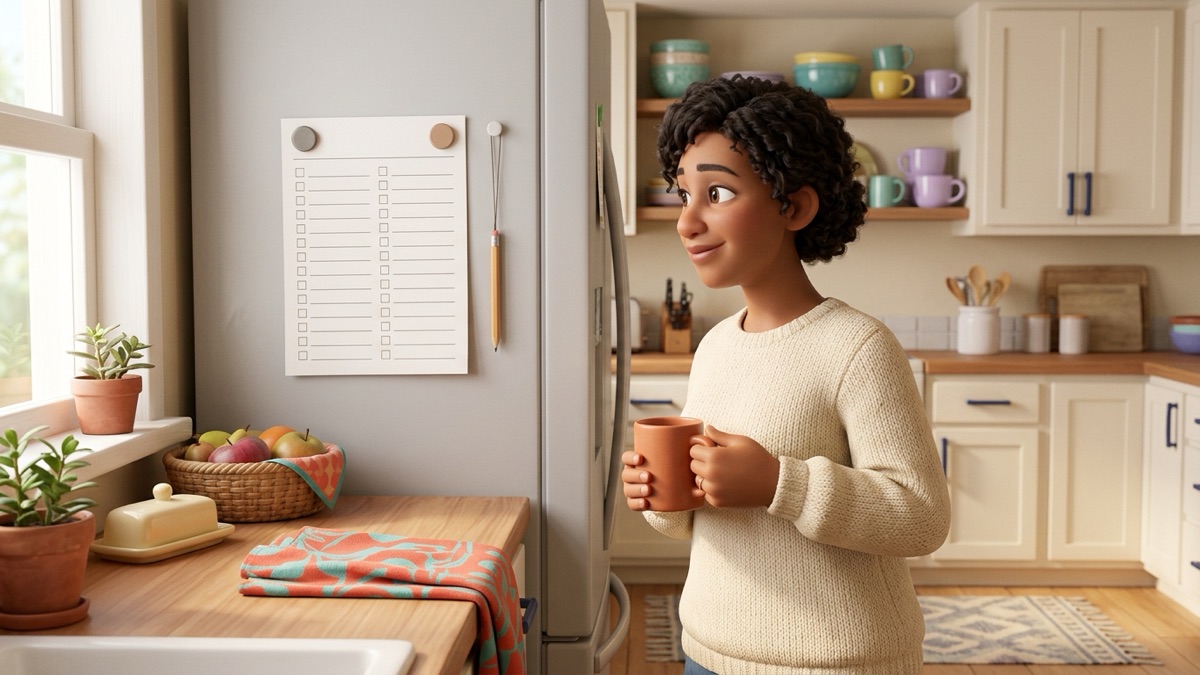
Out of sight often really is out of mind. CHADD suggests posting your organizing list on a bulletin board or the refrigerator door, "somewhere you can see it all the time." For a cleaning schedule, that looks like:
- A one-page schedule on the fridge, or inside a cupboard door you open daily.
- Today's zone as a phone alarm, set for the time of your anchor and labeled with the task.
- Monthly jobs as recurring calendar events. CHADD's planner advice points out that a digital calendar will repeat a recurring event on the right dates for you.
- Each zone's supplies kept in that zone, so starting is not a hunt.
Tip
Name the alarm after the task, not the goal. "Wipe the counter" gets done. "Become a tidy person" gets snoozed.
What is a hard-day minimum?
It is the smallest task on each cleaning day that still counts as doing the day. Bathroom day's minimum might be "wipe the sink." Kitchen day's might be "trash out." On a hard day, you do the minimum and you are done, with no asterisk.
The minimum matters because energy and focus can swing a lot from day to day. A schedule with no floor turns every low day into a missed day, and a few missed days into quitting. A floor keeps the habit alive while asking almost nothing.
Your ADHD cleaning schedule: daily, weekly and monthly
Copy this, then cut anything that does not fit your home.
Daily, about 5 minutes
| Anchor | Task | Hard-day version |
|---|---|---|
| Morning coffee | Empty the dish rack | Skip it |
| Getting home | 5 things back where they live | 1 thing |
| After dinner | Dishes in, counter wiped | Dishes in |
| Before bed | Trash out if full, keys and bag by the door | Keys by the door |
Weekly, 10 to 15 minutes on cleaning days
| Day | Zone | Tasks | Hard-day minimum |
|---|---|---|---|
| Monday | Kitchen | Counters, stovetop, sink, fridge check | Trash out |
| Wednesday | Bathroom | Toilet, sink, mirror, towels | Wipe the sink |
| Friday | Laundry | Wash, dry and fold one load | Start the load |
| Saturday | Bedroom and living room | Sheets, surfaces, floors | Clear one surface |
The fridge check earns its weekly spot: USDA's food safety service suggests making it a habit to throw out perishable food that should no longer be eaten once a week.
Monthly, one job per week
| Week | Job | Time |
|---|---|---|
| 1 | Wipe inside the microwave | 5 min |
| 2 | Wipe the fridge shelves, one at a time | 15 min |
| 3 | Wash the bath mat and the shower curtain liner | 10 min |
| 4 | Vacuum under the sofa cushions and the bed | 10 min |
Heads up
On bathroom day, open a window or run the fan, use one cleaner at a time and follow the label. Never mix bleach with ammonia, vinegar or other cleaners, because the mix can release gases that are dangerous to breathe.
How do you restart after missing days?
Skip the catch-up. Missed zones wait for their own day next week, and you start again at today. If it is Wednesday, it is bathroom day, even if Monday's kitchen never happened. Do the daily reset tonight and you are back on.
CHADD's advice about planners applies here too: if one did not seem to help in the past, do not be afraid to try again, because making a new habit takes time. In a 2010 study where 96 volunteers practiced a simple daily habit, missing one opportunity did not materially affect how the habit formed. It was a small study of eating, drinking and activity habits, not cleaning and not people with ADHD, but it is a kind reminder that one missed day is not the end of anything.
If the same day keeps slipping, that is information, not failure. Move it, shrink it, or hand it to someone else.
The 10 minute version
The smallest ADHD cleaning schedule that still works:
- Daily, 5 minutes: dishes in and trash out, anchored to dinner.
- Three days a week, 5 minutes: kitchen, bathroom and laundry, one each.
- Hard days: one thing, or rest. Rest is part of the plan.
Starting is often the hardest part, so make it a sprint: set a 5 or 10 minute timer, do only today's zone, and stop when it rings. The cleaning sprint timer shows one tiny task at a time, with a virtual body double if you like company. Our guide to body doubling for ADHD explains that idea and how early the research still is.
How do you build yours with the schedule maker?
The free cleaning schedule maker asks five questions and builds the schedule for you:
- Your home. Bedrooms, bathrooms and extras like a desk, an entryway, laundry or pets. Each becomes a zone.
- Your energy, most weeks. "Mostly low", "Up and down" or "Pretty steady." Be honest. Low energy gets smaller tasks, fewer of them and a softer week.
- Days you can clean. Pick fewer than you think. Rest days get only the optional daily reset.
- Minutes on a cleaning day. 5, 10, 15, 20 or 30. On "Up and down" it plans a little under your number, so 15 minutes becomes about 13, which leaves slack.
- Who else helps. With a partner or roommate, each day's tasks are split between you by minutes. With kids, the tasks they can usually help with are marked.
You get a week by zone, a hard-day minimum for each cleaning day (unless you chose "Pretty steady"), a 5 minute daily reset, an every-other-week list for what did not fit, and a monthly list spread over four weeks. It prints on one page, and your answers stay in your own browser.
Try it
Make your schedule with the cleaning schedule maker, print it, and stick it right where your first anchor happens.
For the bigger picture, see our realistic cleaning schedule for five kinds of week, or fill in the printable ADHD cleaning planner. The TidySprint app, coming soon, will turn each day's zone into tiny tasks and a short sprint with a body double.
The takeaway
An ADHD cleaning schedule is less about discipline and more about design. Anchor it, keep it small and visible, give it a floor, and let yourself restart at today. That is a schedule built for the brain you actually have.
TidySprint guides share practical cleaning and routine ideas. They are not medical advice, diagnosis or treatment. If ADHD, depression or anything else is making daily life hard, please talk to a clinician. Using a strong cleaner? Open a window, follow the label, and never mix bleach with ammonia, vinegar or other cleaners.
Questions people ask
What is a good cleaning schedule for ADHD?
One that is small and visible: a 5 minute daily reset, one zone per cleaning day for 10 to 15 minutes, a one-task minimum for hard days, and a short monthly list done one job a week.
How do I stick to a cleaning schedule with ADHD?
Tie each task to something you already do, keep the schedule where you see it every day, and make the hard-day minimum small enough that you can always do it.
What if I miss a day on my cleaning schedule?
Skip the catch-up. Missed zones wait for their own day next week, and you restart with whatever is scheduled for today.
How long should an ADHD cleaning session be?
Short enough to start. CHADD suggests 10 to 15 minute sessions if longer ones feel frustrating, and a 5 minute sprint is a fine place to begin.
Is there a free printable ADHD cleaning schedule?
Yes. The free TidySprint cleaning schedule maker builds one from five questions and prints it on one page. It runs in your browser and needs no account.
Where these facts come from
- NIMH: Attention-Deficit/Hyperactivity Disorder, What You Need to Know: www.nimh.nih.gov/health/publications/attention-deficit-hyperactivity-disorder-wh
- CHADD: Organizing the Home and Office Space: chadd.org/for-adults/organizing-the-home-and-office-space/
- CHADD: Time Management and ADHD, Day Planners: chadd.org/for-adults/time-management-planner/
- Gollwitzer PM, Sheeran P. Implementation Intentions and Goal Achievement: A Meta-analysis of Effects and Processes. Advances in Experimental Social Psychology, 2006: doi.org/10.1016/S0065-2601(06)38002-1
- Lally P, van Jaarsveld CHM, Potts HWW, Wardle J. How are habits formed: Modelling habit formation in the real world. European Journal of Social Psychology, 2010: doi.org/10.1002/ejsp.674
- USDA Food Safety and Inspection Service: Refrigeration and Food Safety: www.fsis.usda.gov/food-safety/safe-food-handling-and-preparation/food-safety-bas
- CDC: Cleaning and Disinfecting with Bleach: www.cdc.gov/hygiene/about/cleaning-and-disinfecting-with-bleach.html
- Poison Control: Chlorine gas: www.poison.org/articles/chlorine-gas
Read next
schedules checklists
A Realistic Cleaning Schedule for Any Kind of Week
schedules checklists
ADHD Cleaning Planner: A Free Printable That Bends

schedules checklists
Printable ADHD Cleaning Checklist, Room by Room (Free)