
Blog body doubling
Body Doubling for ADHD: What It Is and How to Try It

The dishes have been in the sink since Tuesday. Then a friend drops by, sits at the counter with a cup of tea, talks about nothing, and somehow the sink is empty before the tea goes cold. You did not suddenly become more disciplined. You had company, and that trick has a name.
Quick answer
Body doubling means doing a task while someone else is present, in the same room or on a video call, without them helping. CHADD describes a body double as a friend or partner who works at the same time. Many adults with ADHD say it makes starting easier. Research is still early, so treat it as a low-cost experiment.
Key takeaways
- A body double is simply another person nearby while you work on your own task. They do not help, judge or supervise.
- It can happen in person, on the phone, on a video call, in a co-working session, or with a recorded video or an on-screen companion.
- The research is early: surveys and small pilots. There is no controlled trial yet, so nobody can promise it will work for you.
- For cleaning, pair your body double with one small task and a short timer, then check in at the end.
- It is a routine trick, not a treatment. A health care provider or mental health professional is the right person for questions about ADHD itself.
What is body doubling for ADHD?
Body doubling is doing a task you find hard to start or stick with while another person is around. That person is your body double. They are not there to do the task, coach you or check your work. They are just there, doing their own thing.
CHADD (Children and Adults with Attention-Deficit/Hyperactivity Disorder) describes a body double as a friend or partner who works at the same time, either in the same room or virtually over video chat. It says having someone present to check in with can help with accountability, and calls body doubling a support activity that can be easy to do and cost-free. CHADD also notes it is sometimes called having an accountability partner.
Researchers who surveyed people about the habit used a similar definition: using the presence of others to start, stay focused on, or finish a task. That covers a lot of ground, from a roommate reading on the couch while you fold laundry to a stranger on a screen. If you only want the short, plain definition, see what body doubling means. This guide is the long version: the evidence, the options and how to try it.
Why can chores feel easier with someone else around?
Start with what ADHD can make hard. NIMH lists frequent trouble organizing tasks and activities, managing time, and forgetting daily activities such as chores and errands among the signs of inattention. For adults, NIMH says symptoms can lead to disorganization, procrastination and trouble remembering daily tasks. CHADD calls getting and staying organized "a real challenge" and says many adults with ADHD have trouble with clutter and feel overwhelmed or stuck.
Housework is a perfect storm of all that. There is no deadline, no boss and no finish line, just a hundred tiny decisions, and nobody notices whether you start now or at 11 pm. A body double changes a few of those things at once. Suddenly there is a start time, a person who heard you say "I am doing the dishes," and a quiet reason to stay in the room.
CHADD's article suggests body doubling may help because it nudges you to choose a specific project, set aside a specific time for it and be accountable to another person. That makes sense, and it matches what people describe. It is still an explanation, not evidence, which brings us to the honest part.
What does the research on body doubling actually say?
Short version: not much yet, and we would rather say so than oversell it.
CHADD says there "hasn't been significant research" to confirm the benefits of body doubling or explain how it works. We looked too. In September 2026, a search of the Europe PMC research database for the phrase "body doubling" turned up 18 records, and none of them was a trial of body doubling. Here is what does exist:
| Study | What they did | What they found | The limits |
|---|---|---|---|
| Eagle and colleagues, 2024 | Online survey of 220 people about how, when and why they body double | Body doubles can be in person or remote, live or recorded, friends or strangers; tasks included studying, work, dishes, cleaning and exercise | Describes habits; does not test whether it helps |
| Ara and colleagues, 2025 (preprint) | 12 people did a virtual reality building task alone, with a human body double and with an AI one | They finished faster and rated their attention higher with either body double | 12 people, one lab task, not peer reviewed |
| Schuenke and Moore, 2025 (poster) | People with and without ADHD took a reading test alone and with a body double while wearing an EEG headset | No significant effect on performance, focus or calm | Sample size not stated; a reading test may not capture starting a task |
Put together, people who body double describe it in consistent, detailed ways, and the first small experiments point in different directions. That is a good reason to try it with curiosity. It is not a promise. If it helps you, great. If it does not, nothing is wrong with you.
Fun fact
In the 2024 survey, many people said they had been body doubling for years before they ever heard the name. Plenty of us invented it on our own, one "can you just sit here while I do this" at a time.
Is social facilitation the reason body doubling helps?
Maybe, partly. Psychologists have studied how other people's presence changes performance for a long time. In 1965, Robert Zajonc described social facilitation in the journal Science. As a later peer-reviewed paper sums up his theory, having others around raises arousal, which strengthens your most practiced response, so performance tends to improve on well-learned tasks and suffer on new or hard ones.
Body doubling may relate to this, but social facilitation is general psychology, not a test of body doubling in ADHD. The useful part is the pattern. Loading a dishwasher is well learned. Figuring out a brand new filing system while someone watches may feel worse, not better. So save your body double for the familiar chores you avoid, and do the new, fiddly stuff alone or with real help.
What kinds of body doubling can you try?
The 2024 survey found people body double in person and remotely, live and recorded, with people they know and with strangers. In practice, that gives you a menu:
| Type | What it looks like | Good for | Watch out for |
|---|---|---|---|
| Same room | A partner or roommate reads or works nearby while you clean | Laundry, dishes, a messy bedroom | It turning into a chat |
| Phone or earbuds | A friend on speakerphone, both doing chores | Moving from room to room | Talking more than cleaning |
| Video call | A friend on camera, each in your own home | Desk clearing, a kitchen reset | Camera angle and privacy |
| Co-working session | A booked session with a stranger or small group | Paperwork, longer jobs | Cost and camera rules |
| Recorded or live video | A "clean with me" video playing nearby | Late nights, when no one is free | Watching instead of cleaning |
| On-screen companion | A character on a timer who "works" with you | Short sprints, low social energy | It is not a real person |

Two co-working services come up a lot. Focusmate pairs you with one partner on video, and Flow Club runs small hosted group sessions. On their own sites, as of September 2026, both say chores and tidying are welcome. We compare them honestly in Focusmate vs Flow Club, and cover setup, privacy and etiquette for screens in virtual body doubling.
TidySprint is made by Viral Labs and is not affiliated with any other app, author or brand named here.
How do you try body doubling for cleaning today?
You do not need a service or a plan. You need five small steps.
1. Pick one small, familiar job
Not "clean the kitchen." Pick "load the dishwasher" or "clear the table." CHADD's organizing tips include breaking a complex task into smaller steps, and a familiar task is the kind social facilitation suggests company might help with.
2. Pick your double
Whoever is easiest to reach right now. A housemate on the couch counts. So does a friend who also has laundry waiting. No one free? A recorded video or an on-screen companion is a fine place to start.
3. Say the task out loud
Tell them in one sentence: "I am doing the dishes and wiping the counter." Co-working sites build this step in, with a short goal share at the start. It turns a vague intention into a small, friendly promise.
4. Set a short timer
CHADD suggests trying "Just for 15 minutes": set a timer, focus on one thing, then decide whether to go another 15. For a first body doubling session, 10 to 15 minutes is plenty.
5. Check in at the end
Say what you did, even if it is less than planned. "Half the dishes" is a real result. Then stop, or go again if you want to. For nine concrete setups, from speakerphone to a cafe for the paper pile, see body doubling for cleaning.
The 10 minute version
| Minute | You | Your body double |
|---|---|---|
| 0 to 1 | Say one task out loud | Says what they are working on |
| 1 to 9 | Do the task, one small piece at a time | Does their own thing, quietly |
| 9 to 10 | Say what you finished | Says what they finished |
Try it
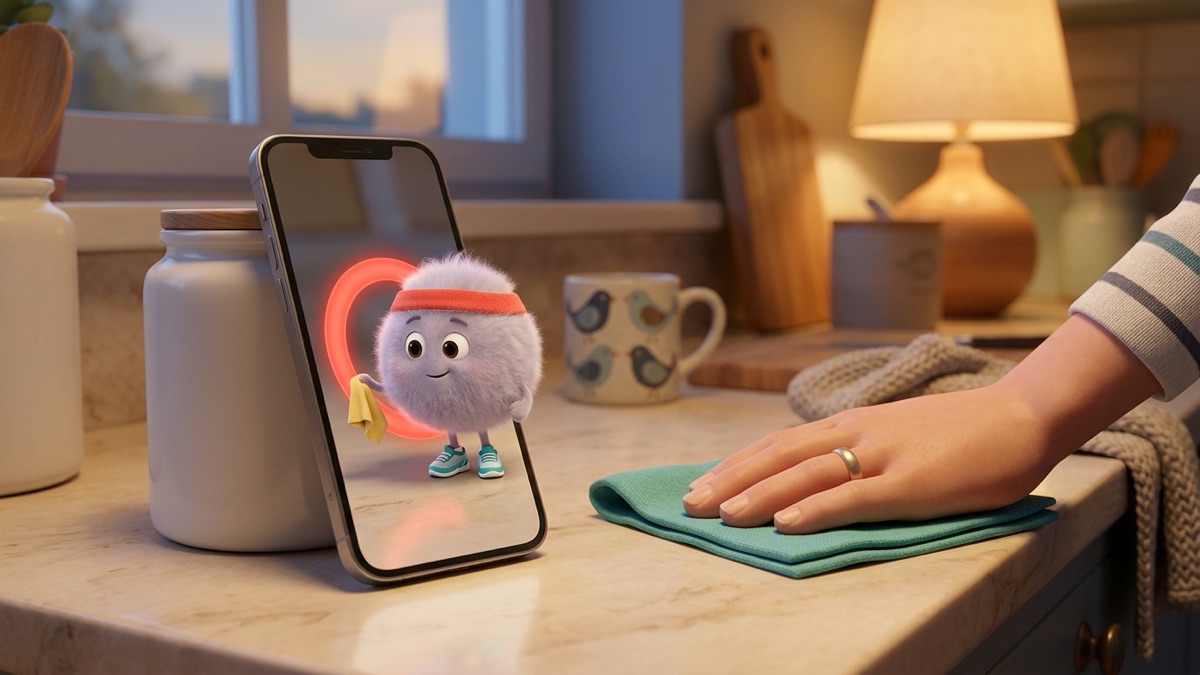
No one around? Open the free cleaning sprint timer, pick a room and 5 or 10 minutes, and leave the body double switched on. Zip, our dust bunny, "cleans" alongside you and says a quiet word now and then while tiny tasks show up one at a time. It runs in your browser, nothing is uploaded, and there is no sign-up.
How do you ask someone to be your body double?
Asking can feel awkward, so make it small and specific. Give a time limit and make it clear they do not have to help.
- "Could you hang out in the kitchen for 15 minutes while I do the dishes? You can scroll your phone."
- "Want to do a cleaning call at 8 tonight? Cameras optional, 20 minutes, we each tackle our own mess."
- "I am doing my paperwork at the library Saturday at 10. Want to bring your laptop?"
Offer to return the favor. Most people have a task they are avoiding too, and a trade feels fair to both of you.
Tip
Agree on the ending before you start. "We check in when the timer goes off" keeps a body doubling session from quietly turning into a two-hour hangout (lovely, but not what the dishes needed).
When does body doubling not work?
CHADD is upfront that it does not work for everyone. Here are the common snags and what to try instead.
- It turns into a hangout. CHADD flags this: with a friend, you may end up socializing instead. Agree on quiet time and save the chat for the end.
- Check-ins eat the time. CHADD also notes that check-ins can take time you would not spend alone. Keep them to one sentence each.
- You feel watched. If a camera or a person makes you tense, point the camera at your hands, keep it off where that is allowed, or try a recorded video or an on-screen companion. Some people find low-demand setups easier, which we cover in body doubling for autistic adults.
- The task is new or hard. Social facilitation suggests company may help most on familiar tasks. Learn the new thing alone first, then bring in a body double for the routine part.
- You are running on empty. On a very low day, rest is part of the method. A 5 minute sprint, or none at all, is fine.
Can body doubling replace ADHD treatment?
No. Body doubling is a routine trick some people find useful for getting started. It is not a treatment for ADHD, and it cannot tell you whether you have ADHD. If ADHD, or something that feels like it, is making daily life hard, a health care provider or mental health professional can help. NIMH says a health care provider is a good first step and can refer you to a psychologist, psychiatrist or clinical social worker.
For the bigger picture on keeping a home with ADHD, start with our zero-shame guide to ADHD cleaning. The TidySprint app, coming soon, will turn a photo of a messy room into tiny tasks and run the sprint with Zip right beside you.
The takeaway
You do not need a perfect system or a perfect friend. You need one small task, one short timer and one other presence, human or fluffy. Try it once, notice what happens, and keep whatever works for you.
TidySprint guides share practical cleaning and routine ideas. They are not medical advice, diagnosis or treatment. If ADHD, depression or anything else is making daily life hard, please talk to a clinician. Using a strong cleaner? Open a window, follow the label, and never mix bleach with ammonia, vinegar or other cleaners.
Questions people ask
What is body doubling for ADHD?
It means doing a task while another person is present, in the same room or on a video call, without them helping. CHADD describes a body double as a friend or partner who works at the same time.
Does body doubling actually work?
Many adults with ADHD say it makes starting easier, but the research is early. CHADD says there has not been significant research on it yet, and we found no controlled trial, so treat it as an experiment.
Can a body double be online?
Yes. CHADD includes working together over video chat, and a 2024 survey found people body double in person and remotely, live or with recorded video, with friends or with strangers.
Do I need an ADHD diagnosis to try body doubling?
No. Anyone can try it, and finding it helpful does not mean you have ADHD. If you have questions about ADHD, a health care provider or mental health professional can help.
What should I do while my body double is here?
Pick one small, familiar task, say it out loud, set a 10 to 15 minute timer and check in at the end. Your body double does their own thing and does not need to help.
Where these facts come from
- CHADD ADHD Weekly: Could a Body Double Help You Increase Your Productivity?: chadd.org/adhd-weekly/could-a-body-double-help-you-increase-your-productivity/
- CHADD: Organizing the Home and Office Space: chadd.org/for-adults/organizing-the-home-and-office-space/
- NIMH: Attention-Deficit/Hyperactivity Disorder, What You Need to Know: www.nimh.nih.gov/health/publications/attention-deficit-hyperactivity-disorder-wh
- NIMH: ADHD in Adults, 4 Things to Know: www.nimh.nih.gov/health/publications/adhd-what-you-need-to-know
- Eagle, Baltaxe-Admony and Ringland (2024), An Investigation of Body Doubling with Neurodivergent Participants, ACM TACCESS: doi.org/10.1145/3689648
- Ara and colleagues (2025), You Are Not Alone: Designing Body Doubling for ADHD in Virtual Reality (arXiv preprint): arxiv.org/abs/2509.12153
- Schuenke and Moore (2025), body doubling and EEG poster abstract, CCSC Central Plains: www.ccsc.org/centralplains/2025/talks/talk-poster16/
- Europe PMC search for "body doubling": www.ebi.ac.uk/europepmc/webservices/rest/search?query=%22body%20doubling%22
- Zajonc (1965), Social Facilitation, Science (Crossref record): api.crossref.org/works/10.1126/science.149.3681.269
- Ukezono and colleagues (2015), Frontiers in Psychology, summary of social facilitation theory: www.frontiersin.org/articles/10.3389/fpsyg.2015.00601/full
- Focusmate: home page and FAQ: www.focusmate.com/
- Flow Club: home page and FAQ: www.flow.club/