
Blog adhd cleaning
ADHD Cleaning: A Zero-Shame Guide to a Tidier Home
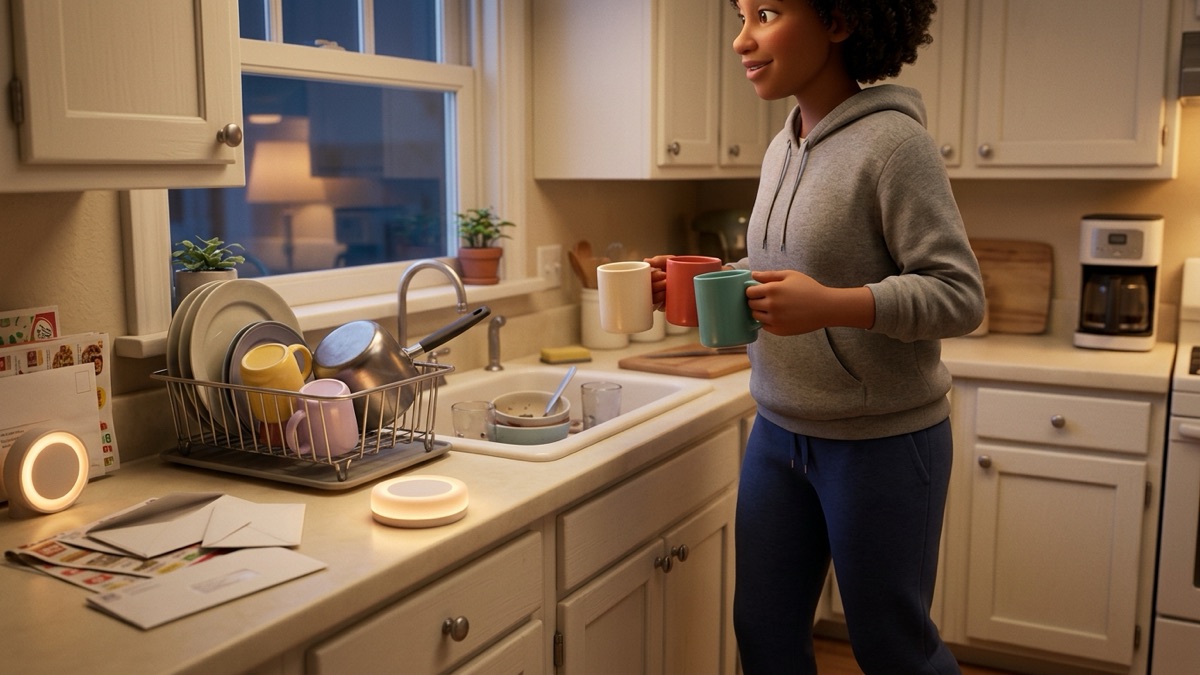
You know how to wash a mug. You have known for years. The hard part is the gap between knowing and actually standing up, and on some days that gap is roughly the size of the whole kitchen.
If that sounds familiar, you are in the right place. This is a guide to cleaning with ADHD without the lectures: why it is genuinely harder, and the handful of things that make it easier.
Quick answer
ADHD cleaning works best when you shrink the job until starting is easy: one tiny, concrete task at a time, a visible timer for 5 to 15 minutes, company if it helps, a small reward at the end, and a home for everything. Skip the marathon. A short daily reset helps keep the mess from building back up.
Key takeaways
- Cleaning is hard with ADHD for real reasons. NIMH lists trouble organizing tasks, managing time and remembering daily chores among the signs of inattention. It is not a character flaw.
- Shrink every job to a task you could finish in a minute or two: "clear one chair", not "clean the bedroom".
- Make time visible with a timer and stop when it stops. Short sprints you repeat beat marathons you dread.
- Company, a reward picked in advance and a home for every item do a lot of the remembering and motivating for you.
- A 10 minute reset most evenings helps keep the mess from piling back up. Skipped days are part of the plan, not the end of it.
Why is cleaning so hard with ADHD?
Because cleaning a home is not one job. It is dozens of small decisions with no deadline, no finish line and nobody watching, which is a tough mix for an ADHD brain.
The official wording backs this up. NIMH lists frequent trouble organizing tasks and activities, managing time and meeting deadlines, and forgetting daily activities such as chores and errands among the signs of inattention. In adults, NIMH says symptoms can lead to disorganization and procrastination, trouble remembering daily tasks and losing things. CHADD's National Resource Center on ADHD, which is funded by the CDC, calls getting and staying organized "a real challenge" and says many adults with ADHD have trouble with clutter at home and feel overwhelmed or stuck.
You are also far from the only one. A CDC report estimated that in 2023 about 6.0% of US adults, roughly 15.5 million people, had a current ADHD diagnosis, based on what people said in a national survey. More than half of them (55.9%) got that diagnosis at 18 or older, so if you figured this out late, that is common too.
Here is how those descriptions tend to show up at home:
| What it feels like | The ADHD piece | What helps |
|---|---|---|
| "I don't know where to start" | Trouble organizing tasks (NIMH) | One tiny task, picked for you |
| "I'll do it in 5 minutes," three hours ago | Trouble managing time (NIMH) | A timer you can see |
| The laundry is still in the washer. Again. | Forgetting daily chores (NIMH) | A written plan where you will see it |
| "Where are my keys?" | Losing things (NIMH) | A home for everything, a launch pad |
| The pile is so big you sit down instead | Feeling overwhelmed or stuck (CHADD) | A smaller job and some company |
None of this is a character flaw. Messy homes are normal homes, and a brain that finds chores hard is simply a brain that needs a different on-ramp.
The ADHD community has names for some of this: doom piles for stacks still waiting on a decision, "ADHD paralysis" for the stuck feeling, time blindness for the hour that vanished. They are community words, not diagnoses, and our explainer on why cleaning is hard with ADHD goes deeper.
One honest note before the practical part: this is a cleaning guide, not medical advice, and TidySprint is not a treatment for ADHD. Only a clinician can diagnose ADHD. If you are wondering whether ADHD is part of your story, NIMH says a health care provider is a good first step, and they can refer you to a psychologist, psychiatrist or clinical social worker.
What actually helps with ADHD cleaning?
Six things do most of the heavy lifting. You do not need all six. Pick the one that sounds least annoying and start there.
1. Shrink the task until it is almost silly
"Clean the kitchen" is not a task. It is a project wearing a task costume. CHADD's advice on to-do lists uses this exact example: "clean the kitchen" is so broad that you might skip right over it, so break it into separate steps like emptying the dishwasher, wiping down the counters, throwing out expired food and sweeping.
A good tiny task has one verb, one object and a finish line you can see: "Clear one chair." "Carry every mug to the sink." "Throw away 3 pieces of trash." If you could do it in a minute or two, it is the right size. NIMH describes cognitive behavioral therapy as building skills for organization and daily tasks, such as breaking large tasks into smaller steps, which tells you how basic and useful this skill is.
2. Make time visible
Time is slippery when you cannot see it. A timer turns "later" into a shape, and it gives the job an end, which makes it easier to begin.
CHADD suggests short organizing sessions of 30 to 60 minutes, or 10 to 15 minutes if longer feels frustrating, and a timer set in 15-minute blocks with breathers in between. Its "Just for 15 minutes" trick is lovely in its simplicity: set a timer, focus on one thing, and when it goes off, decide whether you want another 15. If not, you stop. Our guide to speed cleaning builds whole routines out of short, timed bursts like these.
3. Bring some company
CHADD describes a body double as a friend or partner who works at the same time as you, in the same room or over video chat, and calls it an easy, cost-free support. People use one for dishes, laundry, bills and taxes. Having someone there to check in with can help with accountability.
Two honest caveats. CHADD says there "hasn't been significant research" to confirm the benefits or explain how it works, so this is a thing to try, not a guarantee. And it does not suit everyone: a friend on a call can turn cleaning into chatting (fun, but the dishes stay put). Our body doubling guide covers in-person, online and on-screen versions.
4. Pick the reward before you start
CHADD suggests choosing a reward before you start an organizing task, and then making sure you actually give it to yourself when you finish. Deciding first gives your brain something to walk toward.
Small is fine: a cup of tea you drink sitting down, one song you love played loud, 5 minutes of a game, guilt free. The reward is earned by the sprint, not by a spotless room.
5. Give everything a home near where you use it
A lot of mess is really "no home" mess. The thing has nowhere obvious to go, so it goes on the chair, and the chair becomes a wardrobe. CHADD suggests clear containers if you avoid putting things away because you are afraid you will never find them again, and a "launch pad" by the front door: a small table with a basket for keys, glasses and wallets.
Our guides to ADHD home organization and ADHD organization tools go room by room. If the real problem is simply too much stuff, start with how to declutter when you feel overwhelmed.
6. Do a small daily reset
CHADD's suggestion: spend 10 minutes each night on a quick pickup. Carry a basket through the home and drop things off where they belong. That is it. It is not a deep clean. It is what keeps Tuesday's mess from quietly becoming Saturday's mountain.
It works best when it is short and the same every day: dishes in, 5 things back, wipe one counter, trash out if it is full.
A worked example: one messy kitchen, six tiny tasks
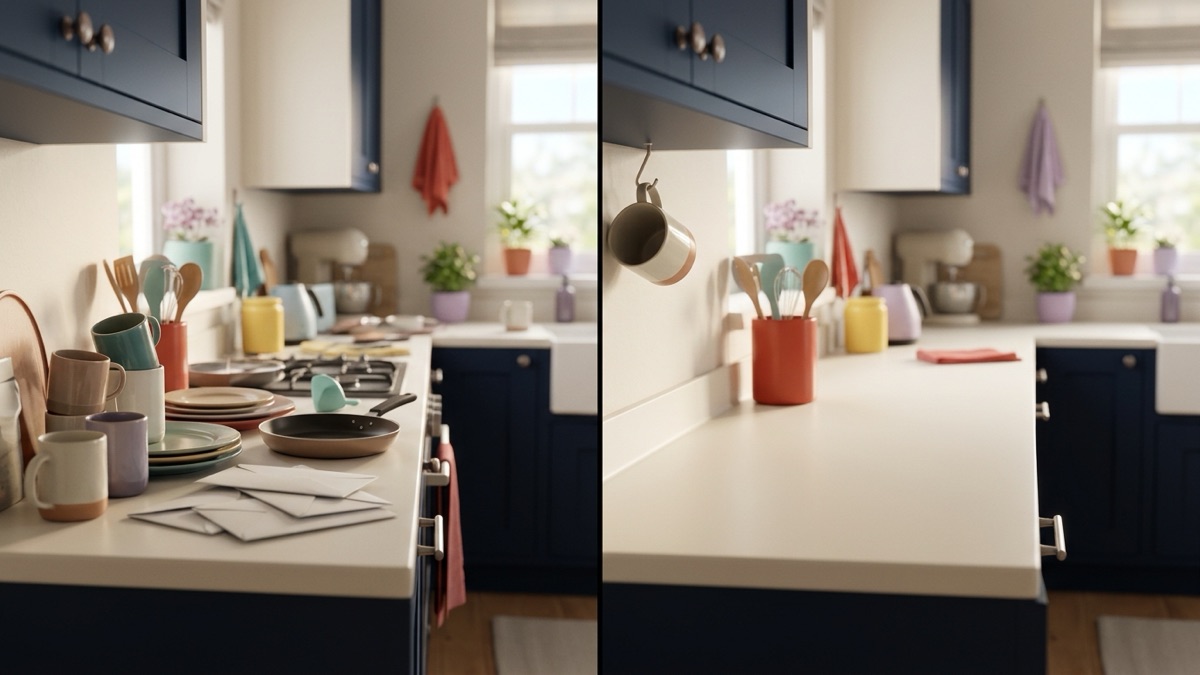
Picture a real kitchen on a weeknight. Dishes in the sink and on the counter, a full trash can, the drying rack still loaded from two days ago, and a pan that has been "soaking" since last night (it is not soaking, it lives there now).
Here is the same kitchen as six tiny tasks, in an order that makes each one easier than the last:
| Step | Tiny task | About | Why this order |
|---|---|---|---|
| 1 | Take out the trash if it is full | 2 min | Makes room for everything else, zero decisions |
| 2 | Empty the drying rack into the cupboards | 3 min | Clears space for the dirty dishes |
| 3 | Load 10 things into the dishwasher, or wash 10 things | 4 min | A number beats "all the dishes" |
| 4 | Clear one stretch of counter, about one arm long | 3 min | One clear spot changes how the room feels |
| 5 | Wipe that stretch and the cool stovetop with warm, soapy water | 2 min | A visible payoff with one plain cleaner |
| 6 | Refill the pan with hot, soapy water, then walk away | 1 min | Future you gets an easier pan |
That is about 15 minutes. If you stop after step 3, it still counts: the trash is out and the sink is lighter. Then take your reward.
Notice what is not on the list: no "deep clean the oven", no "organize the pantry". Those are separate projects for a different day.
The 10 minute version
For a day with 10 minutes and not much energy:
- Set a timer for 10 minutes. A visible one, if you have it.
- Pick one room, or "anywhere" if everything looks equally bad.
- Do trash first, then cups and dishes, then one surface.
- Stop when the timer stops, even in the middle of a task.
- Take the reward you picked.
Ten minutes on most days adds up quietly, and it never asks you to find a free Saturday.
Try it
The free cleaning sprint timer does the picking for you. Choose a room (or "I don't know where to start") and 5, 10, 15 or 20 minutes, and it shows one tiny task at a time while Zip, our dust bunny body double, cleans alongside you on screen. Skip anything that does not fit today. It runs in your browser and nothing is uploaded.
How do you keep a home tidy with ADHD after a good day?
The trick is making the next day easier than starting from zero.
Write the plan down and put it where you will see it. A plan in your head is one more thing to remember. Keep it simple: a few cleaning days, one zone per day, and a tiny "hard day" task for the days you have nothing left. The free cleaning schedule maker builds that kind of week from five questions, and our guide to a realistic cleaning schedule explains why fewer days usually beats more. If you like paper, our guide to picking an ADHD planner for adults helps you choose one you will actually open.
Expect gaps. You will skip days. Everyone does. The plan that survives is the one that lets you restart with the smallest task instead of the whole backlog.
Share the load. If you live with other people, a chore chart for adults makes the split visible, so nobody has to be the household's memory.
Pick your tools on purpose. Some people like an app that nudges them, others want paper on the fridge. Our roundup of cleaning apps for ADHD compares the options, and our ADHD cleaning tips are sorted by the problem you are having today.
For a room-by-room walkthrough of the whole place, see how to clean a house.

What if your home feels too far gone?
Sometimes the problem is every room, and the thought of starting makes you want to lie on the floor. That is a normal reaction to a big job. Start with how to clean a messy room, which works through one small area at a time, and give yourself permission to take weeks rather than a weekend.
Sometimes cleaning feels impossible because everything feels impossible. If you have had a sad or "empty" mood that will not lift, lost interest in things you usually enjoy, or felt worn out for weeks, that may be more than ADHD or a busy month. NIMH lists these among common signs of depression and says to talk to a health care provider if symptoms persist. Our guide to depression cleaning is gentler still. If you are struggling right now in the US, you can call or text 988 to reach the 988 Suicide and Crisis Lifeline, free and confidential, any time.
And if letting go of things causes real distress, and the clutter makes rooms hard to use for what they are for, that can be hoarding disorder. The American Psychiatric Association describes it as persistent difficulty parting with possessions because of a perceived need to save them. It is a mental health condition, not a messy room, and a mental health professional can help.
Heads up
Use one cleaner at a time and follow the label. Never mix bleach with ammonia (found in many glass cleaners), vinegar or other acids such as some toilet bowl cleaners, because the mix can release gases that are dangerous to breathe. Open a window or run the fan when you use anything strong. Poison Help in the US: 1-800-222-1222.
The takeaway
Cleaning with ADHD is not about becoming a different person. It is about making the job small enough, visible enough and kind enough that the person you already are can start it. One tiny task. A timer. Maybe some company. A reward. Then stop, and call it a win.
The TidySprint app, coming soon, will turn a photo of a messy room into a short plan of tiny tasks and run the sprint with you. Until then, pick one task from the kitchen table above and give it 5 minutes. That is a real start.
TidySprint guides share practical cleaning and routine ideas. They are not medical advice, diagnosis or treatment. If ADHD, depression or anything else is making daily life hard, please talk to a clinician. Using a strong cleaner? Open a window, follow the label, and never mix bleach with ammonia, vinegar or other cleaners.
Questions people ask
Why is cleaning so hard with ADHD?
NIMH lists trouble organizing tasks, managing time and remembering daily chores among the signs of inattention, and CHADD calls getting and staying organized a real challenge. Cleaning a home asks for all three at once, which is why breaking it into tiny tasks helps so much.
What is the best way to clean with ADHD?
There is no single best method, but many people do well with short timed sprints of 5 to 15 minutes, one tiny task at a time, a reward picked in advance and a quick daily reset. Stopping when the timer ends is part of the plan.
How do I start cleaning when I feel stuck?
Pick the smallest task you can think of, like carrying every mug to the kitchen or throwing away 3 pieces of trash, and set a timer for 5 minutes. You are allowed to stop when it ends. Starting is the hard part, and a tiny start still counts.
Does body doubling help with cleaning?
Many people with ADHD say having someone around makes it easier to start and keep going, and CHADD describes a body double as an easy, cost-free support. Research on it is still early and small, so treat it as something worth trying rather than a sure thing.
Is a messy house a sign of ADHD?
Not on its own. Busy weeks, low energy, stress, illness and depression can all make a home messy. Only a clinician can diagnose ADHD, so if you are wondering, a health care provider is a good first step.
Where these facts come from
- NIMH: Attention-Deficit/Hyperactivity Disorder, What You Need to Know: www.nimh.nih.gov/health/publications/attention-deficit-hyperactivity-disorder-wh
- NIMH: ADHD in Adults, 4 Things to Know: www.nimh.nih.gov/health/publications/adhd-what-you-need-to-know
- CDC MMWR (2024): ADHD Diagnosis, Treatment, and Telehealth Use in Adults: www.cdc.gov/mmwr/volumes/73/wr/mm7340a1.htm
- CHADD National Resource Center on ADHD: Organizing the Home and Office Space: chadd.org/for-adults/organizing-the-home-and-office-space/
- CHADD National Resource Center on ADHD: Time Management and ADHD, To-Do Lists: chadd.org/for-adults/time-management-and-adhd-to-do-lists/
- CHADD ADHD Weekly: Could a Body Double Help You Increase Your Productivity?: chadd.org/adhd-weekly/could-a-body-double-help-you-increase-your-productivity/
- NIMH: Depression: www.nimh.nih.gov/health/publications/depression
- 988 Suicide and Crisis Lifeline: 988lifeline.org/
- American Psychiatric Association: What Is Hoarding Disorder?: www.psychiatry.org/patients-families/hoarding-disorder/what-is-hoarding-disorder
- CDC: Cleaning and Disinfecting with Bleach: www.cdc.gov/hygiene/about/cleaning-and-disinfecting-with-bleach.html
- Poison Control: Chlorine gas: www.poison.org/articles/chlorine-gas