Blog messy room
How to Clean Your Room, Step by Step, in Short Sprints
Cleaning your room is one job on paper and about fifty tiny jobs in real life. The trick is to stop looking at the whole room and look at the next ten minutes instead. Here is the whole thing, split into three short sprints, with a clear finish line for each one.
Quick answer
Clean your room in three 10 minute sprints. Sprint 1: trash, dishes and every piece of clothing into one basket. Sprint 2: put things back where they live and clear the surfaces. Sprint 3: make the bed, wipe the surfaces and vacuum. Take a short break between sprints, and stop whenever you need to.
Key takeaways
- Three sprints of 10 minutes each, about 35 to 40 minutes with breaks, cleans a typical bedroom.
- Each sprint has a finish line, so you always know when you are done and can stop without guilt.
- The order is floor first, surfaces second, actual cleaning last.
- The fast version is one 10 minute sprint. The deep version adds two more.
- Stopping after any sprint still counts. The room keeps what you did.
What do you need to clean your room?
Take 2 minutes to set up, then start the timer. You need:
- A trash bag.
- A laundry basket (or a pillowcase, or a big bag).
- A "goes elsewhere" basket for things that live in another room.
- A cloth, and either plain water with a drop of dish soap or one all-purpose cleaner.
- A timer and something to listen to.
Tip
Put your phone on the timer screen and leave it on the dresser. You will want to check it, and checking a countdown is a lot less of a detour than checking messages.
How do you clean your room step by step?
Each sprint is 10 minutes, with a 2 to 5 minute break between them. The steps are numbered straight through, so you always know where you are.
Sprint 1: clear the floor and the bed (10 minutes)
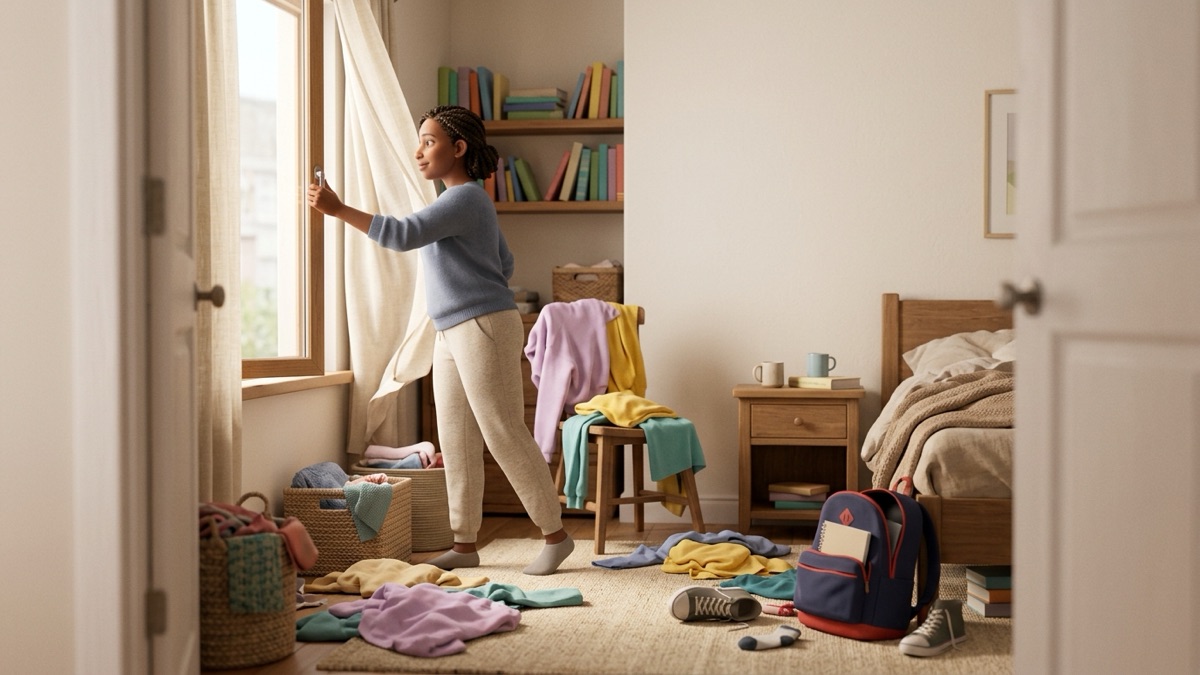
- Open the curtains and a window. Light and air first.
- Do one lap with the trash bag. Walk around the room once and pick up only trash: wrappers, receipts, tissues, empty bottles.
- Collect the dishes. Every cup, plate, bowl and fork goes into one stack by the door.
- Clothes into the basket. Everything on the floor, the chair and the bed goes in. If you can clearly tell something is clean, lay it on the bed instead. If you are not sure, it goes in the basket.
- Take the trash and dishes out of the room. Out of the room is enough. Washing them is a kitchen job for another time.
Done looks like: you can walk from the door to the bed without stepping on anything, and the bed is clear except for clean clothes waiting to be put away.
Sprint 2: give things back their homes (10 minutes)
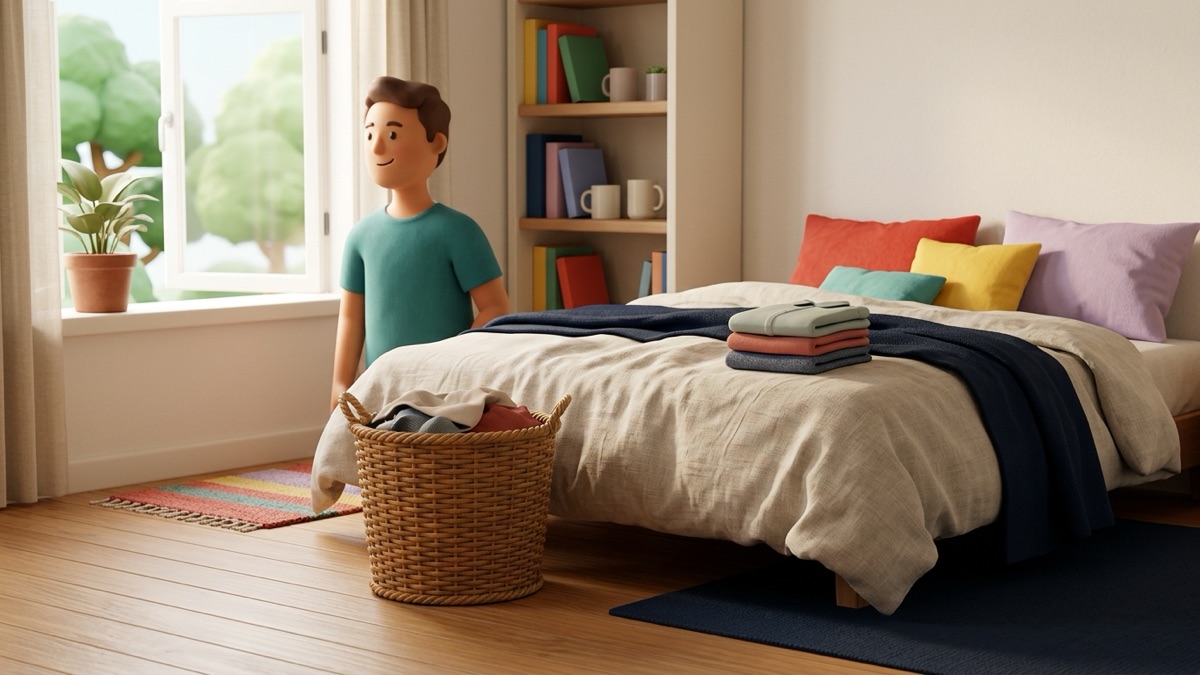
- Put away the clean clothes on the bed. Fold them, hang them, or put them in a drawer unfolded. Unfolded in a drawer beats folded on a chair.
- Put back anything that has a home. Books on the shelf, shoes in pairs, chargers in their spot, bag on its hook. If you know where it goes in about 3 seconds, it goes there now.
- Everything else goes in the "goes elsewhere" basket. Items for other rooms, and the things that have no home yet. Do not stop to solve them.
- Clear the nightstand, the dresser top and the desk. Leave only what you use every day. Three things on a nightstand is a good target.
Done looks like: the surfaces are mostly bare, nothing is on the floor, and there is one basket of things to deal with later.
Sprint 3: make it feel clean (10 minutes)
- Make the bed. Pulling the covers up counts. A made bed is the biggest single surface in the room, so it changes the whole look.
- Wipe the surfaces. A dry cloth for dust, a damp one for sticky spots. Nightstand, dresser, desk, and the light switch while you are there.
- Vacuum or sweep the open floor. The middle of the room and the path from the door. Under the bed can wait.
- Deal with the baskets. Take the laundry to the washer if it is full, and either walk the "goes elsewhere" basket around the home or park it by the door for tomorrow.
Done looks like: the bed is made, the surfaces are clean, the floor is vacuumed and the room smells like fresh air. Close the window and enjoy it.
Heads up
Use one cleaner at a time and follow its label. Never mix bleach with ammonia (found in many glass cleaners) or with vinegar or other acids, because the mix can release gases that are dangerous to breathe. If you use anything stronger than soap and water, open a window first.
What does each sprint look like at a glance?
| Sprint | Focus | Done looks like | Bad day version |
|---|---|---|---|
| 1 (10 min) | Trash, dishes, clothes into one basket | A clear path from door to bed | Just the trash lap and the cups |
| 2 (10 min) | Things back home, surfaces cleared | Bare surfaces, one "elsewhere" basket | Only the nightstand |
| 3 (10 min) | Bed, wipe, floor | Made bed, clean surfaces, vacuumed middle | Just pull the covers up |
Even the bad day column leaves the room noticeably better. That is the point of sprints.
Try it
Open the free cleaning sprint timer, pick Bedroom and 10 minutes, and press start three times with a break in between. The bedroom deck hands you one tiny task at a time, like "Put every piece of clothing on the floor into the hamper or on the bed" and "Clear the nightstand down to 3 things," while Zip, the dust bunny body double, cleans alongside you.
What is the fastest way to clean your room? (the 10 minute version)
When you only have 10 minutes, do one mixed sprint that hits the things people notice most:
- 2 minutes: trash lap with the bag.
- 3 minutes: every piece of clothing into the basket.
- 2 minutes: cups and plates out of the room.
- 2 minutes: pull the covers up and straighten the pillows.
- 1 minute: clear the nightstand.
The floor, the bed and the surfaces are what make a room read as clean. For a slightly longer quick plan, see how to clean your room fast.
How do you deep clean your room? (the deep version)
When you have more time and energy, add two more 10 minute sprints after the three above.
Sprint 4: fabric and dust (10 minutes)
- Strip the bed and start the sheets in the wash, on the setting the care label allows.
- Dust from high to low: the top of the wardrobe, shelves, the lamp, then the surfaces. Dust falls, so the floor goes last.
- Wipe the door handle, the light switch and the window sill.
Sprint 5: the hidden spots (10 minutes)
- Vacuum under the bed and along the edges of the room.
- Sort one drawer or one shelf. Only one.
- Put fresh sheets on the bed: a spare set, or the washed ones once they are dry.
For the full top-to-bottom version, see how to deep clean your room.
How do you make yourself clean your room when you do not want to?
The goal is not to feel like it. It is to make starting smaller than the reluctance.
- Promise only sprint 1. Or only 5 minutes. CHADD suggests planning short sessions, as short as 10 to 15 minutes if longer ones feel frustrating, and using a timer or a music playlist to mark them.
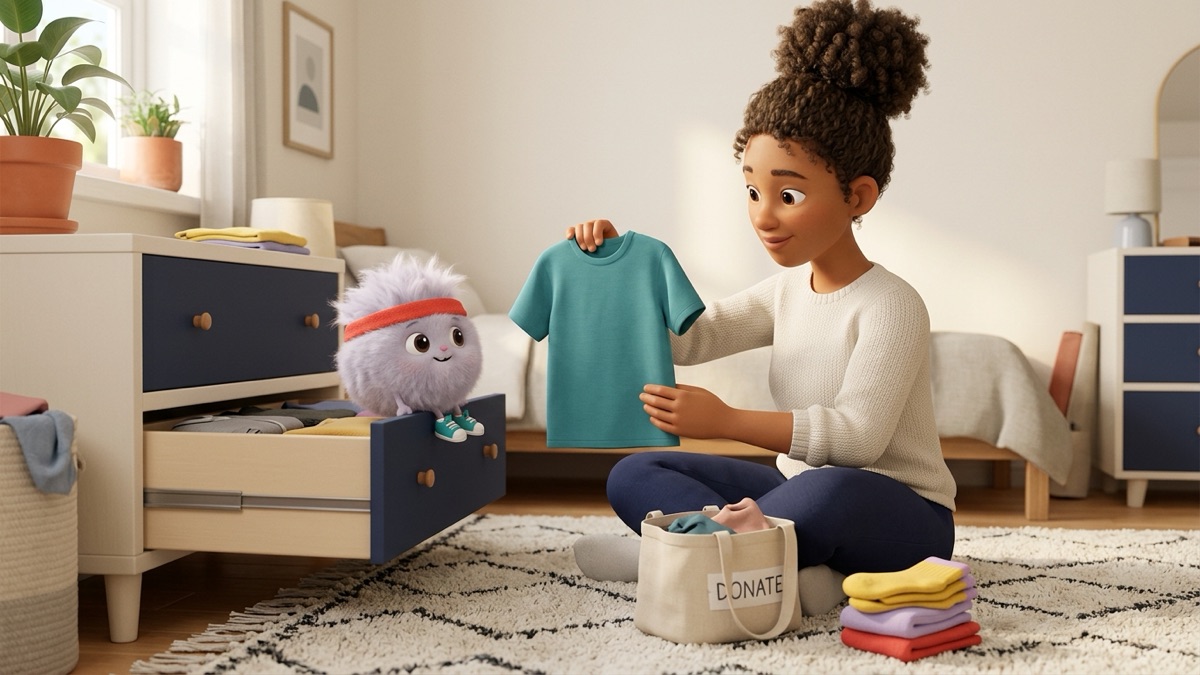
- Get some company. CHADD describes a body double as a friend or partner who works at the same time as you, in the same room or over video chat. Research on it is early, and it does not suit everyone, but many people say company makes starting easier. Call a friend who also has a messy room and clean at the same time.
- Plan the reward first. A cup of tea, one episode, a short walk. Decide it before you start so the end of the sprint has something waiting.
How often should you clean your room?
There is no rule, only what keeps your room livable for you. One pattern to try: a 5 minute reset most nights and this three-sprint clean once a week. If your room has been building up for a while, start with the guide on how to clean a really messy room, which covers where to start when the floor has disappeared. Once it is clean, how to keep your room clean has seven tiny habits that help it stay that way.
The short version
Three sprints: floor and bed, then homes and surfaces, then bed, wipe and floor. Ten minutes each, a short break between, and a clear finish line so you always know when you can stop. Do one sprint on a hard day and all three on a good one. The TidySprint app, coming soon, will turn a photo of your room into a short list of tiny tasks and run the sprint with you. For now, a basket, a bag and a timer are plenty.
TidySprint guides share practical cleaning and routine ideas. They are not medical advice, diagnosis or treatment. If ADHD, depression or anything else is making daily life hard, please talk to a clinician. Using a strong cleaner? Open a window, follow the label, and never mix bleach with ammonia, vinegar or other cleaners.
Questions people ask
How long does it take to clean your room?
With this plan, about 35 to 40 minutes: three 10 minute sprints plus short breaks. A room that has been building up for weeks may need two sessions on two different days.
What should I clean first in my room?
Trash, dishes and the clothes on the floor. They make the biggest visible difference and need almost no decisions, so they get you moving.
How can I clean my room quickly?
Do one 10 minute sprint: trash into a bag, every piece of clothing into one basket, cups out of the room, covers pulled up and the nightstand cleared. That is the fast version, and it changes the room more than you would expect.
How do I clean my room when I have zero motivation?
Promise yourself only the first sprint, or even just 5 minutes, and let yourself stop after it. Company helps many people, so a friend on a call or an on-screen body double can make starting easier.
How often should I clean my room?
There is no single right answer. A 5 minute reset most nights plus this three-sprint clean once a week keeps most bedrooms manageable, and you can adjust from there.
Where these facts come from
- CHADD: Organizing the Home and Office Space: chadd.org/for-adults/organizing-the-home-and-office-space/
- CHADD ADHD Weekly: Could a Body Double Help You Increase Your Productivity?: chadd.org/adhd-weekly/could-a-body-double-help-you-increase-your-productivity/
- CDC: Cleaning and Disinfecting with Bleach: www.cdc.gov/hygiene/about/cleaning-and-disinfecting-with-bleach.html
- Poison Control: Chlorine gas: www.poison.org/articles/chlorine-gas