
Blog chore charts
Chore Chart for Adults: A Free Printable That Is Not Babyish
You tried a chore chart once. It had cheerful clip art, a column for gold stars, and by Thursday it was a quiet record of everything you did not do. That is not a character flaw. Most chore charts were designed for 8-year-olds, and grown-up weeks do not run on stickers.
Quick answer
A chore chart for adults lists each chore with its zone, how many minutes it takes, who owns it and which day it lands on, plus a hard-day minimum for weeks that go sideways. Keep it to one page, put it where you will see it, and spend 5 minutes a week adjusting it instead of starting over.
Key takeaways
- Kid-style charts fail adults because they reward ticking boxes, and a row of empty boxes turns into a report card.
- A useful adult chart answers six questions for every chore: where, what exactly, how long, who, when, and what counts on a hard day.
- Solo, couple and roommate charts look different. Solo is about energy, couples about invisible work, roommates about rotation.
- A small chart you follow beats a full one you ignore. Three cleaning days is a real plan.
- Review it for 5 minutes each week. A chart you adjust keeps working; a chart you abandon becomes wallpaper.
Why do chore charts for kids fail grown-ups?
A kid's chart has a parent behind it who noticed the jobs, wrote them down and decides when they are done. An adult chart has nobody behind it but you (and maybe a partner or roommates who also have jobs, moods and inboxes). So the parts a parent quietly handled have to be built into the chart itself.
Here is where the classic chart breaks:
- The tasks are too big. "Clean kitchen" is a project with a dozen steps. Your brain looks at it, estimates an hour, and quietly goes to check your phone.
- There is no time on it. Adults plan around minutes. A chart that does not say how long a task takes cannot tell you whether it fits before work.
- The rewards are for children. A sticker for doing laundry feels silly, and an empty box feels like a small scolding from the fridge.
- It is all or nothing. Miss Tuesday and the whole week looks ruined, so the chart comes down on Friday.
- Nobody owns the noticing. Someone has to see that the soap is running out, remember trash night and book the plumber. That planning work is real work, and a kid's chart never lists it.
If you have ADHD, or recognize yourself in it, a chart that does the remembering can be worth a lot. NIMH lists trouble organizing tasks and forgetting daily activities such as chores and errands among signs of inattention. A chart will not change how your brain works, but it moves the list out of your head and onto a wall. If you are wondering whether ADHD is part of your story, a health care provider or mental health professional is the right person to talk to. Our ADHD cleaning guide goes deeper on the cleaning side.
What does an adult chore chart need?
Six columns do almost all the work. Everything else is decoration.
| Column | The question it answers | Example |
|---|---|---|
| Zone | Where? | Kitchen |
| Task | What exactly? | Wipe counters and stovetop |
| Minutes | How long? | 5 |
| Owner | Whose job, start to finish? | You |
| Day | When? | Monday |
| Hard-day minimum | What still counts on a rough day? | Wipe the counter by the sink |
Zones group tasks by area, so one cleaning day is one part of the home. You get less walking back and forth and fewer decisions about what is next.
Task is a verb and a thing you can finish: "wipe the stovetop", not "kitchen". If you cannot picture yourself done with it in under 20 minutes, split it.
Minutes keep the chart honest. Guess, then time one task with a phone timer the first week. Small jobs are often quicker than they feel (taking out the trash is about 3 minutes), and big ones hide extra steps (a load of laundry, start to put away, is several short jobs spread over hours).
Owner means one name per task, and that person handles all of it: noticing it needs doing, doing it, and restocking whatever ran out. "We'll both do the bathroom" usually means the bathroom happens when the most bothered person cracks.
Day spreads the load. You do not need seven cleaning days. Three or four, plus a short daily reset, covers most small homes.
Hard-day minimum is the smallest useful version of that day's job. CHADD suggests breaking a complex task into smaller steps and keeping sessions short, even 10 to 15 minutes when longer feels frustrating. The hard-day minimum takes that one step further: on a bad day, one small step counts, and the chart stays alive.
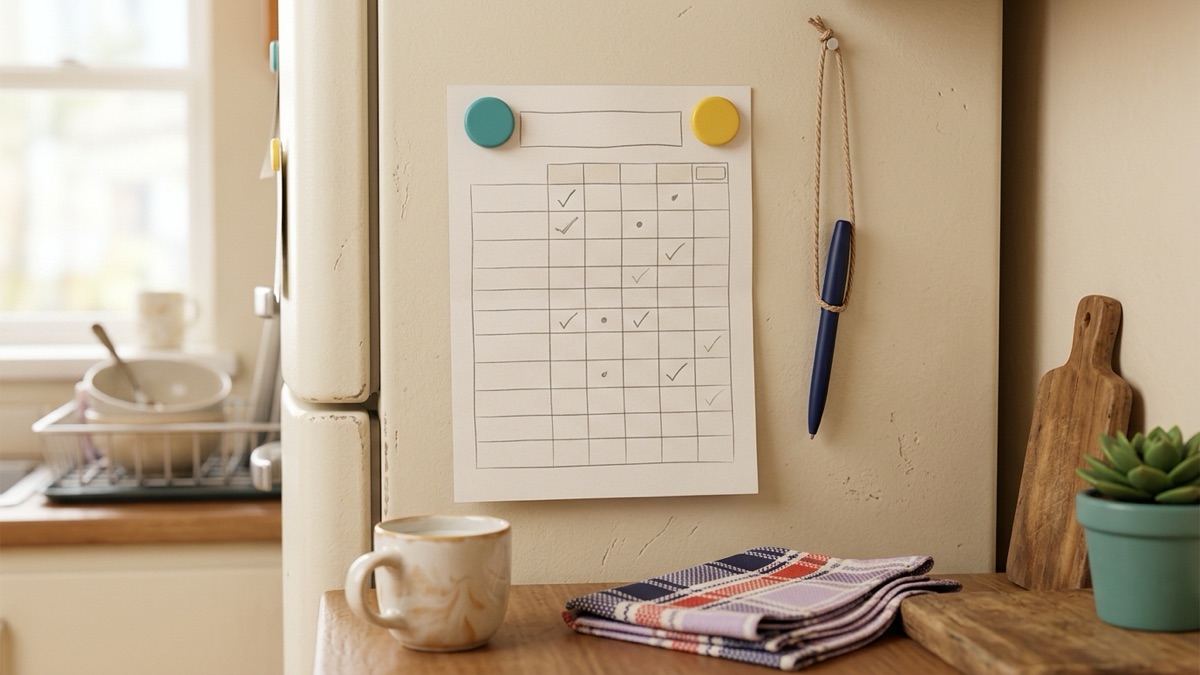
What does a solo chore chart for adults look like?
Living alone means every job is yours, so the chart is really about energy. This one assumes three cleaning days of about 15 minutes, plus a 5 minute reset on any day you feel like it.
| Day | Zone | Tasks, with minutes | Hard-day minimum |
|---|---|---|---|
| Monday | Kitchen | Counters and stovetop (5), sink (3), trash and recycling out (3) | Trash out |
| Wednesday | Bathroom | Toilet (5), sink and counter (3), mirror (2), fresh towels (2) | Fresh towels |
| Saturday | Bedroom and laundry | Start a load (2), change the sheets (10), move the load along (2) | Start the load |
| Any day | Daily reset | Dishes in, 5 things back where they live, wipe the counter | 5 things back |
Tuesday, Thursday, Friday and Sunday are rest days on purpose. Rest is part of the plan, not a gap in it. The daily reset borrows from CHADD's idea of a 10 minute pickup each night, cut down to 5 minutes for the nights when 10 feels like a lot.
What about a chore chart for couples?
Couples need a chart for a different reason: the chores are split, but the noticing often is not. The fix is to put the invisible jobs on the chart as their own rows, each with one owner.
| Task | Owner | Day | Minutes |
|---|---|---|---|
| Plan meals and write the grocery list | You | Sunday | 15 |
| Groceries: order or shop, then put away | Partner | Monday | 30 |
| Kitchen counters and sink | Partner | Monday and Thursday | 8 each |
| Bathroom | You | Wednesday | 12 |
| Laundry, start to put away | You | Saturday | 30, in bits |
| Bills, appointments and birthdays | Partner | Friday | 15 |
Notice the first and last rows. Meal planning and remembering birthdays rarely make it onto a chart, and they are often the jobs that cause the most friction. Our guide to the couples chore chart covers how to split by preference and energy instead of exact minutes, plus a 10 minute weekly check-in script.
And a chore chart for roommates?
Roommates are not a couple and should not have to negotiate like one. The simplest fair system: everyone handles their own room and their own dishes, and the shared areas rotate on the same day every week.
| Shared area | Week 1 | Week 2 | Week 3 |
|---|---|---|---|
| Kitchen: counters, sink, stovetop, floor | Jo | Kai | Mia |
| Bathroom: toilet, sink, shower, towels | Kai | Mia | Jo |
| Trash, recycling and the supplies list | Mia | Jo | Kai |
Week 4 starts back at the top. Write one line under the table that says what done looks like for each area ("counters clear and wiped, sink empty"), because a lot of roommate friction comes from different standards rather than different effort. Our printable chore chart has a roommate layout with a "done means" column built in.

Tip
Rotation day works best when it is tied to something that already happens, like trash night or the Sunday grocery order. "Whenever" never comes around.
How do you make an adult chore chart in 10 minutes?
This is the 10 minute version. Set a timer and stop when it rings, even if the chart is not perfect. You will fix it at the first weekly review anyway.
Minutes 1 to 3: list the jobs by zone
Walk through your home, or picture it, and write the jobs that need doing about once a week, grouped by room. Include the invisible ones: groceries, bills, the supplies list.
Minutes 4 and 5: add minutes
Put a number next to each job. Guess. Round up the small ones to 5.
Minutes 6 and 7: pick days and owners
Choose your cleaning days (fewer than you think) and give each zone a day. If you share a home, put one name on each job.
Minutes 8 and 9: write a hard-day minimum
For each cleaning day, circle the one smallest task that still helps. That is the fallback.
Minute 10: put it somewhere visible
Fridge, inside a cabinet door, next to the front door. Take a photo so you have it on your phone too.
Try it
Skip the handwriting and use the free cleaning schedule maker. Answer five questions about your home, your energy, your days, your minutes and who else helps. Choose "Partner or roommate" and it tags each task You or Partner and balances the minutes between you. It adds a 5 minute daily reset, a hard-day minimum on each cleaning day when your energy is low or up and down, and it prints on one page. It runs in your browser, and your answers stay on your device.
How do you review a chore chart each week?
The weekly review is what separates a chart that works from a chart that becomes wallpaper. It takes 5 minutes. Do it at the same time each week, ideally with coffee.
Ask three questions:
- What got done? Tick it. Notice it. That counts.
- What got skipped twice? Something is wrong with that task, not with you. Make it smaller, move it to a better day, give it to someone else, or drop it.
- What is coming next week? Guests, travel, a brutal work week. Lighten the chart before the week starts, not halfway through it.
Edit the chart in pen instead of rewriting it. A chart covered in small changes is a chart that is being used. Our guide to the weekly chore chart has a longer Sunday review ritual if you want one.
Fun fact
In the 2025 American Time Use Survey, about 81 percent of people ages 15 and over did some household activity (housework, cooking, lawn care or household management) on an average day, spending about 2 hours on it. You are in very large company.
What if nobody follows the chart?
It happens. Before you tear it down, check which of these is going on:
- The chart is too big. Cut it in half. Seriously, half. You can add tasks back once the smaller version has run for three weeks.
- A task is on the wrong day. Vacuuming on the night you get home at 8 is not going to happen. Move it.
- Ownership was never agreed. A chart one person wrote and taped up is a request, not a plan. Sit down together and let everyone swap.
- It is out of sight. A chart in a drawer is a chart that does not exist. Move it to where you stand every day.
- Nothing makes it pleasant. Adults like rewards too. Pair the bathroom with a podcast, or clean alongside someone else. A timer with a body double, like the cleaning sprint timer, can make 10 minutes go by faster.
Heads up
If a task on your chart uses a strong cleaner, use one product at a time, open a window or run the fan, and follow the label. Never mix bleach with ammonia, vinegar or other acids, because the mix can release gases that are dangerous to breathe.
Want more formats, like chore wheels, cards or whiteboards? Our chore chart ideas round-up covers them, and the chore chart template shows three filled-in examples you can copy. The TidySprint app, coming soon, will turn a photo of the room on today's row into a short list of tiny tasks.
The takeaway
An adult chore chart is not a sticker chart with smaller handwriting. It is a short, honest list: where, what, how long, who, when, and what still counts on a bad day. Start with fewer tasks than feels respectable, put it where you will see it, and give it 5 minutes each week. The chart that bends is the one that lasts.
TidySprint guides share practical cleaning and routine ideas. They are not medical advice, diagnosis or treatment. If ADHD, depression or anything else is making daily life hard, please talk to a clinician. Using a strong cleaner? Open a window, follow the label, and never mix bleach with ammonia, vinegar or other cleaners.
Questions people ask
What should be on a chore chart for adults?
Each chore as a specific action, the zone it belongs to, how many minutes it takes, one owner, the day it happens, and a hard-day minimum. Leave off stickers and points. Ten to fifteen real tasks on one page is plenty.
How do you make a chore chart for adults that does not feel childish?
Swap gold stars for minutes and owners. Write tasks the way you would text them to a friend, such as wipe the stovetop, and add a small fallback for rough days so a missed day does not turn the chart into a guilt list.
How many chores should an adult do a day?
Whatever you can keep up. A 5 minute daily reset plus 10 to 20 minutes on three or four days a week covers most small homes. Start smaller than you think and add later.
How do roommates split chores fairly?
Everyone looks after their own room and their own dishes, and the shared areas rotate weekly on a set day. Write down what done looks like for each shared area so nobody argues about standards later.
Can adults use a chore chart app instead of paper?
Yes. Pick the place you already look every day. Paper on the fridge works for many households, and a shared list or app suits people who live on their phones. The format matters less than keeping it small and reviewing it weekly.
Where these facts come from
- NIMH: Attention-Deficit/Hyperactivity Disorder, What You Need to Know: www.nimh.nih.gov/health/publications/attention-deficit-hyperactivity-disorder-wh
- CHADD: Organizing the Home and Office Space: chadd.org/for-adults/organizing-the-home-and-office-space/
- US Bureau of Labor Statistics: American Time Use Survey, 2025 Results (released June 25, 2026): www.bls.gov/news.release/atus.nr0.htm
- CDC: Cleaning and Disinfecting with Bleach: www.cdc.gov/hygiene/about/cleaning-and-disinfecting-with-bleach.html
- Poison Control: Chlorine gas: www.poison.org/articles/chlorine-gas