
Blog adhd cleaning
ADHD Paralysis and Cleaning: How to Get Unstuck

You have been staring at the same corner of the kitchen for 40 minutes. You know what needs to happen: dishes, counter, floor. Your body has apparently not received the memo. The longer you sit, the bigger the job grows, and the harder it is to explain to anyone (including yourself) why you cannot just stand up.
Quick answer
ADHD paralysis is a community term for knowing what to do and not being able to start. To get unstuck, make the first step tiny: 2 minutes on one surface. Add a visible timer, someone or something in the room with you, and permission to stop when the timer ends. Starting is the win.
Key takeaways
- "ADHD paralysis" and "ADHD freeze" are community words for a real experience: wanting to start and not being able to. They are not a diagnosis.
- CHADD calls starting a task an executive function skill, and says task paralysis comes with overwhelm and procrastination.
- The way out is smaller, not harder: one surface, 2 minutes, one hand moving.
- A timer, a body double and a reward picked in advance do the motivating so you do not have to.
- If being stuck runs through your whole life, a health care provider or mental health professional can help you understand why.
What do people mean by ADHD paralysis?
Search the phrase and you will find a thousand descriptions that sound the same: sitting on the couch knowing the sink is full, scrolling instead of standing up, feeling frozen by a job that would take 15 minutes if you could just begin. Some people call it ADHD freeze. Some call it task paralysis. It is a community name, not a clinical one, and using it does not mean you have ADHD. Only a clinician can diagnose ADHD.
What the official sources say lines up with the experience, though. NIMH lists frequent trouble organizing tasks and activities, managing time, and forgetting daily activities such as chores among the signs of inattention in ADHD. For adults, NIMH says symptoms can lead to procrastination, poor planning and trouble remembering daily tasks.
CHADD, the national ADHD organization, has summarized the idea more directly. One of its news summaries says task paralysis comes with overwhelm, procrastination and low self-esteem, and that you can improve your ability to start something by breaking it into smaller, manageable chunks. Another CHADD summary calls task initiation an important executive function skill, and notes that some tasks become emotionally loaded "walls of awful" that are hard to begin even when they look easy.
So the stuck feeling is not you being difficult. It is a known hard part, with a known first move: make the task smaller.
Why is cleaning the task that freezes people most?
Cleaning is the perfect storm for a stuck brain. It has no clear start (where do you even begin?), no clear end (a kitchen is never "done"), and a hundred tiny decisions hidden inside it. Every one of those decisions costs a little energy before your hands move.
It is also the chore with the most feelings attached. A messy room can feel like a verdict. If you have been told you are lazy or careless before, walking into that room means walking into the verdict again. That is the "wall of awful" CHADD's summary describes: the task looks like 15 minutes of work and feels like a mountain.
Nothing about this is a character flaw. Messy homes are normal homes. Our ADHD cleaning guide covers the bigger picture. This post is about the exact moment you are stuck, and how to get your body moving again.

How do you get unstuck? The 2 minute start
The trick most people find works is not more willpower. It is a smaller first step than feels reasonable. Here is the routine, in order.
Step 1: Shrink the job to one surface
Not "clean the kitchen." One counter. One side of the sink. One chair. CHADD's organizing advice for adults starts with the same idea: break a complex task into smaller steps, and if a session feels frustrating, plan 10 to 15 minutes instead of an hour. When the task is one surface, your brain can picture the end, and a picture of the end is what starting needs.
Step 2: Give it 2 minutes
Set a timer for 2 minutes. Not 20. The deal you make with yourself is: 2 minutes on that one surface, then you are allowed to stop. Most of the time the hard part was the first 30 seconds, and once your hands are moving you keep going. When you do not, you still cleaned for 2 minutes, which is 2 minutes more than the last 40 sitting there.
Step 3: Move one hand before you decide anything
Stuck brains get stuck on decisions. So skip the deciding. Pick up the nearest thing that obviously has a home (a mug, a spoon, a sock) and put it there. Then the next. Decisions like "where does this go" can wait for a later sprint. Right now you are only touching the obvious.
Step 4: Add company
CHADD describes a body double as a friend or partner who works at the same time, in the same room or over video, and calls it an easy, cost-free support. Company can be a person, a video call with a friend who is also folding laundry, or a virtual stand-in on a screen. Research on body doubling is early: a 2024 survey of 220 people found many had used it for years for tasks like dishes and cleaning before they knew its name, but that study did not test whether it improves results. Try it and see.
Step 5: Stop when the timer ends, on purpose
This is the part people skip, and it is the part that makes the next start easier. If every sprint turns into a 2 hour marathon, your brain learns that starting means losing the whole evening, and it will fight you harder next time. Stop at the timer. Rest. If you want another round, choose it fresh.
Try it
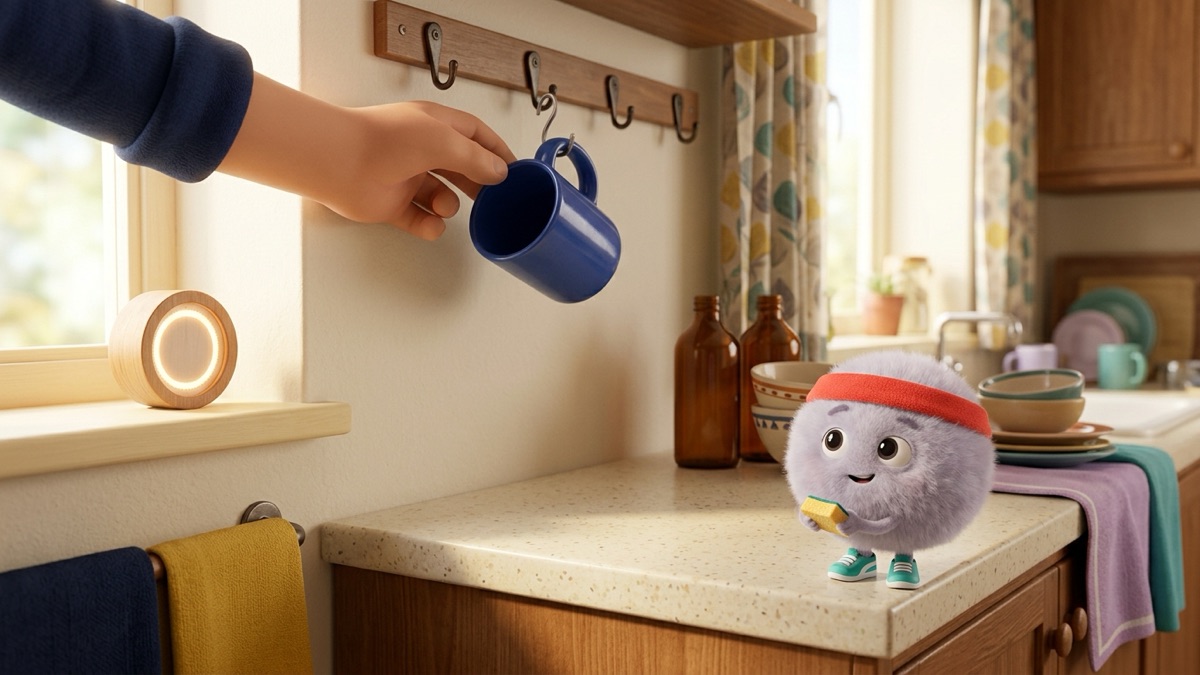
The free cleaning sprint timer is built for exactly this moment. Pick a room (or "I don't know where to start"), pick 5, 10 or 15 minutes, and it hands you one tiny task at a time, like "Carry every cup and mug to the kitchen." Turn on the body double and Zip, a dust bunny in running shoes, cleans alongside you. Skipping a task is allowed, and it says so.
Which unsticking move fits which kind of stuck?
Not every freeze is the same. Match the move to the feeling.
| How it feels | What is probably happening | The smallest move |
|---|---|---|
| "I don't know where to start" | Too many options, no first step | Pick the surface closest to you. Start there. |
| "It's too big, what's the point" | The whole job is in your head at once | Set 2 minutes. Only one surface exists. |
| "I keep picking things up and putting them down" | Every item needs a decision | Only touch things with an obvious home. Rest go in one basket. |
| "I'm avoiding the room itself" | Feelings attached to the mess | Do 2 minutes with the door open and music on. Company helps here. |
| "I have no energy" | A low day, not a motivation problem | 5 things back where they live, sitting down if you need to. Done. |
If low energy is the usual state rather than a bad day, our guide on how to clean with no energy has a slower version of all of this.
The 10 minute unstick
When you have a little more than 2 minutes in you, run this. It is the same idea, stretched.
| Minutes | Do this |
|---|---|
| 0 to 1 | Set a 10 minute timer, open a window, put on one song you like |
| 1 to 3 | Everything that belongs in the kitchen goes to the kitchen. Do not wash anything yet |
| 3 to 5 | Trash and recycling into a bag. Only the obvious |
| 5 to 8 | One surface: clear it to bare, wipe it with a damp cloth |
| 8 to 10 | Stand back, look at the one clear surface, and pick your reward |
Ten minutes will not finish a room. It will end the freeze, and it will give you one clear surface to look at, which is a surprisingly good argument for the next sprint.
Tip
Pick the reward before you start, not after. CHADD's organizing page suggests choosing a reward before an organizing task and giving it to yourself when you finish. Tea sitting down, one episode, 5 minutes outside. Small, immediate, decided in advance. Our post on a dopamine menu for cleaning has a whole menu of them.
How do you make the freeze happen less often?
You cannot schedule your way out of a stuck brain, but you can lower the number of decisions waiting for you when you walk in.
- Give the big things a home. The mail pile freezes you because it has nowhere to go. One tray by the door, and it has a home.
- Keep the first step written down. A list that says "kitchen" is a wall. A list that says "clear the left counter" is a door. Our guide to ADHD planners for adults covers how to write the kind of list you will actually use.
- Plan short by default. CHADD suggests sessions of 30 to 60 minutes for organizing, or 10 to 15 if longer feels frustrating. For most stuck days, 10 to 15 is the honest number.
- End every session with a reset you can see. A single clear surface tomorrow morning makes tomorrow's start smaller.
- Expect the freeze, and plan for it. Some days you will sit there for 40 minutes anyway. That is not a failed system. Do the 2 minute version, and count it.
Heads up
This is a cleaning post, not medical advice. If getting started is hard across work, bills, relationships and home, not just the dishes, talk to a health care provider or mental health professional. NIMH notes that stress, sleep problems, anxiety and depression can cause symptoms that look like ADHD, which is why a full evaluation matters. TidySprint is not a treatment for ADHD.
More small, practical moves live in our ADHD cleaning tips. The TidySprint app, coming soon, will turn a photo of the room you are avoiding into a short plan of tiny tasks, so the first step is already picked for you.
The takeaway
Being stuck is not the same as not caring. It is usually the job being too big for the moment you are in. So make the moment smaller: one surface, 2 minutes, one hand moving, and permission to stop. You do not have to feel ready. You only have to start tiny.
TidySprint guides share practical cleaning and routine ideas. They are not medical advice, diagnosis or treatment. If ADHD, depression or anything else is making daily life hard, please talk to a clinician. Using a strong cleaner? Open a window, follow the label, and never mix bleach with ammonia, vinegar or other cleaners.
Questions people ask
What is ADHD paralysis?
It is a community term, not a diagnosis, for the stuck feeling when you know exactly what needs doing and still cannot start. CHADD describes task paralysis as coming with overwhelm and procrastination, and calls starting a task an executive function skill.
Is ADHD paralysis the same as laziness?
No. Wanting to do the task and being unable to begin it is the whole problem. NIMH lists trouble organizing tasks and managing time among signs of inattention in ADHD. If it is a pattern in your life, a health care provider or mental health professional can help you sort out what is going on.
How do you get out of ADHD paralysis fast?
Shrink the job until it is almost silly: one surface, 2 minutes, one hand. Set a visible timer, put someone or something in the room with you, and stop when the timer ends. Starting is the goal, not finishing.
Does body doubling help with task paralysis?
Many people say company makes starting easier, and CHADD calls a body double an easy, cost-free support. The research so far is small and early, mostly surveys and pilots, so try it and see what it does for you.
Should I see someone about ADHD paralysis?
If getting started is hard across many parts of your life, not just cleaning, it is worth talking to a health care provider. Stress, sleep problems, anxiety and depression can look similar, which is why NIMH says a full evaluation matters.
Where these facts come from
- NIMH: Attention-Deficit/Hyperactivity Disorder: What You Need to Know (revised 2024): www.nimh.nih.gov/health/publications/attention-deficit-hyperactivity-disorder-wh
- NIMH: ADHD in Adults: 4 Things to Know: www.nimh.nih.gov/health/publications/adhd-what-you-need-to-know
- CHADD ADHD in the News: task paralysis summary (September 14, 2023): chadd.org/adhd-in-the-news/overcome-adhd-task-paralysis/
- CHADD ADHD in the News: Getting Started on Inexplicably Tough Tasks (August 14, 2025): chadd.org/adhd-in-the-news/getting-started-on-inexplicably-tough-tasks/
- CHADD: Organizing the Home and Office Space: chadd.org/for-adults/organizing-the-home-and-office-space/
- CHADD ADHD Weekly: Could a Body Double Help You Increase Your Productivity?: chadd.org/adhd-weekly/could-a-body-double-help-you-increase-your-productivity/
- Eagle, Baltaxe-Admony and Ringland (2024): An Investigation of Body Doubling with Neurodivergent Participants, ACM TACCESS: doi.org/10.1145/3689648
Read next
adhd cleaning
ADHD Cleaning: A Zero-Shame Guide to a Tidier Home

adhd cleaning
A Dopamine Menu for Cleaning: Make Tidying Feel Good


adhd cleaning
ADHD Cleaning Tips That Work on Low-Focus Days

body doubling
Body Doubling for Cleaning: 9 Ways to Try It Today
decluttering
Where to Donate Clothes: A No-Guilt Guide