
Blog depression cleaning
Depression Cleaning: Gentle Ways to Start When It Is Hard

The mug on the nightstand has been there long enough to feel like part of the furniture. You keep meaning to start, and every time you look at the room, it gets a little heavier. If that is where you are today, you are in the right place, and nobody here is keeping score.
Quick answer
Depression cleaning means cleaning in the smallest possible pieces when your mood and energy are low. Start with one thing that has a built-in stop: one cup to the sink, one bag of trash, one clear surface. Sit down where you can, ask for help, and talk to a health care provider if low mood lasts.
Key takeaways
- A messy home during a hard stretch says nothing bad about you. Fatigue and trouble concentrating, both on NIMH's list of depression signs, make every chore bigger.
- The smallest start counts: one cup, one bag, one surface. Then you are allowed to stop.
- Sitting down is allowed. A lot of tidying works from the couch or the edge of the bed.
- Help is part of the plan, not a failure: a friend, some company on a call, a cleaning service.
- Cleaning is not a treatment for depression. A health care provider can help, and in the US, 988 is there at any hour.
What is depression cleaning?
"Depression cleaning" is not a medical term. It is what people call cleaning when low mood has drained the energy, focus and interest that chores usually run on. The goal changes. Instead of a spotless home, you aim for a home that works: something clean to eat from, a clear path to the bed, trash that has left the room.
It helps to know why a sink of dishes can feel like a mountain. NIMH's list of common signs of depression includes fatigue, lack of energy or feeling slowed down; loss of interest or pleasure in activities; and difficulty concentrating, remembering or making decisions. NIMH also lists an inability to meet responsibilities. Cleaning asks for all of those at once: energy to stand, focus to keep going, and a hundred small decisions about where things go.
This post cannot tell you whether you have depression. Only a health care provider can diagnose depression, and NIMH says a diagnosis requires symptoms most of the day, nearly every day, for at least 2 weeks. What this post can do is make the next ten minutes smaller.
Why does cleaning feel impossible when you are depressed?
Three things tend to stack up at the same time.
Every task costs more. When energy is low, standing at the sink, bending for laundry and carrying a bag downstairs each take a real bite. The room did not get bigger. Your budget got smaller.
Tidying is mostly decisions. Picking up one shirt means deciding clean or dirty, hamper or hanger, now or later. Multiply that by a whole room and it is a lot of deciding for a brain that is already tired.
The pile starts talking. After a while, the mess can feel like a verdict on you. It is not one. It is a room with some things in it, and things can be moved a little at a time. The shame often weighs more than the laundry does.
Our guide to messy rooms and depression looks at this loop more closely, including where it is easiest to break.
What is the smallest way to start?
Pick a start with a built-in stop. You are not signing up to clean the room. You are signing up for one thing, and when it is done, you can stop with a clear conscience.
| Tiny start | What you do | About how long | You can stop when |
|---|---|---|---|
| One cup | Carry one cup or mug to the sink | 1 minute | It is in the sink |
| One bag | Fill one bag with trash you can reach | 3 to 5 minutes | The bag is tied |
| One surface | Clear one nightstand, chair or stretch of counter | 5 minutes | You can see the surface |
| One load | Put clothes in the washer and press start | 3 minutes | The machine is running |
| One window | Open the curtains or a window | 1 minute | The light is in |
Why "one" works
One is small enough to start on a bad day, and it leaves a result you can see. If one cup turns into five, lovely. If it stays one cup, that also counts. The point is that you get to decide after the first one, not before.
Gather first, sort later
When energy is low, skip the sorting. Put all the dishes in one spot, all the clothes in one pile, all the trash in one bag. Putting things away can be a different day. A room with three piles is easier to face than a room with three hundred scattered things.
Tip
Keep a trash bag and a basket next to the spot where you spend the most time. When the bag is within reach, a one-minute tidy can happen without getting up.
What can you clean sitting down?
More than you might think. Bring the task to you instead of taking yourself to the task.
- Laundry: fold it on the couch, or just flatten it into a stack. Flat counts.
- Mail: sort it with a recycling bag between your feet. Keep or recycle, nothing else.
- Trash in reach: fill one bag with whatever you can touch from where you sit.
- The coffee table or nightstand: clear it into a basket, then wipe it with one cloth.
- Dishes: a tall stool at the sink turns washing up into a sitting job.
Our guide on how to clean with no energy has a full sit-down list, one-minute tasks and tools that save steps.
Try a 5 minute sprint
Sometimes the hardest part is choosing where to begin. A short timer with one small task at a time takes that choice off your plate.
Try it
Open the free cleaning sprint timer, pick "I don't know where to start" and 5 minutes, and do only the task on the card. Skip anything that feels like too much. You can end the sprint at any point, and when the ring runs out, you are done, even if the room is not.
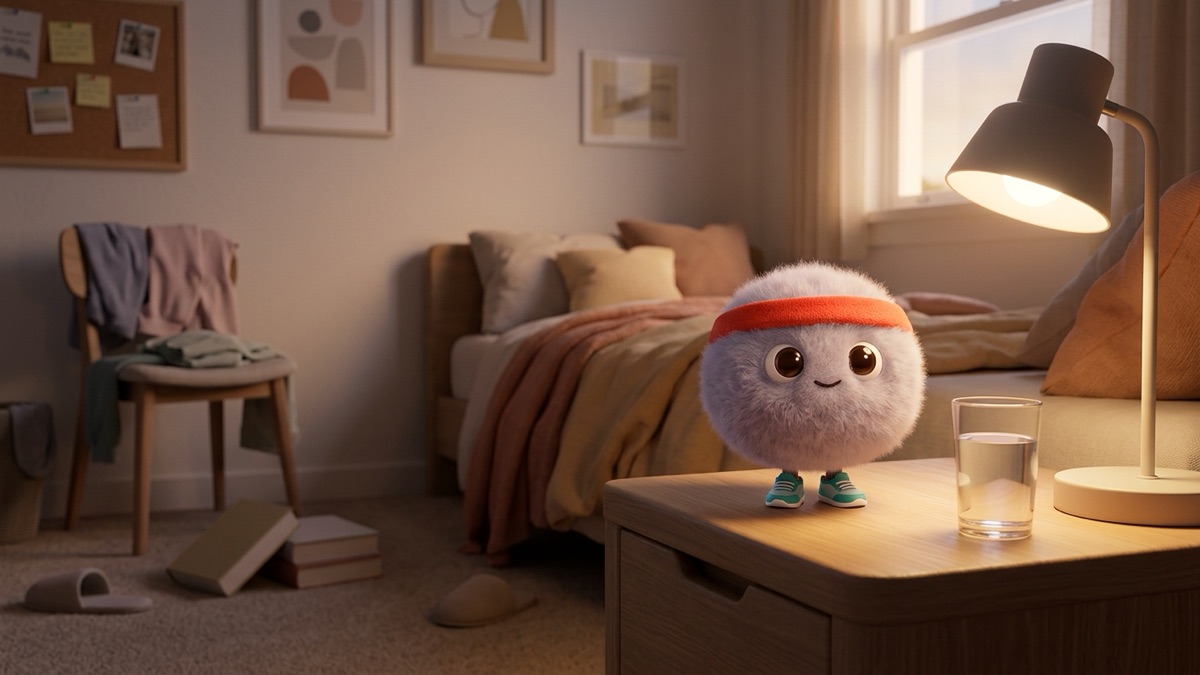
The cards are tiny on purpose: "Carry every cup and mug to the kitchen", "Clear one chair", "Open a window for 5 minutes of fresh air". There is an optional on-screen companion, a dust bunny called Zip, and a small reward idea at the end, like putting on one song you love. It is a cleaning timer and nothing more, which is the point: five minutes, then you decide.
The 10 minute version
If you have a little more in you, this order gives the most visible change for the least effort. Stop after any step.
- Open the curtains or a window (1 minute). Light makes the room easier to look at.
- Trash into one bag (3 minutes). No decisions needed.
- Cups and dishes to one spot (2 minutes). The sink, or a tray if the sink is full.
- Clothes into one pile or basket (2 minutes). Clean and dirty can share a pile today.
- Clear one surface (2 minutes). The nightstand, or the spot where you eat.
Then sit down. That was a real reset. When you have more energy on another day, how to clean a messy room walks through a whole room in order.
Heads up
If you use a cleaner, use one product at a time, open a window or run the fan, and follow the label. Never mix bleach with ammonia (found in many glass cleaners), vinegar or other acids. CDC and Poison Control warn that the mix can release gases that are dangerous to breathe.
How do you ask for help?
Asking is hard when you feel like the mess is your fault. It is not a moral failing, and help is a normal tool, not a last resort. NIMH's tips for living with depression include connecting with people and talking to people you trust about how you are feeling.
Specific asks are easier to say yes to:
- "Could you come over and sit with me while I do the dishes? You do not have to help."
- "Could you take three bags down to the trash on your way out?"
- "Can we stay on a call while I fold laundry? I just want company."
- "Could you do the bathroom while I do the kitchen, and then we get takeout?"
The first and third are a kind of body doubling: doing a task with someone else around, in person or on a video call. CHADD describes a body double as a friend or partner who works at the same time, and notes there has not been significant research yet to confirm the benefits. It does not work for everyone, but some people find company makes starting easier. Body doubling for cleaning has more ways to try it.
Lower-effort swaps count as help too. Paper plates for a week, a wash and fold laundry service, groceries delivered: none of these is anything to be embarrassed about.

When is a cleaning service worth it?
A professional clean is worth considering when:
- The backlog has been bigger than your energy for weeks.
- One big reset would let you keep up with tiny daily tasks afterward.
- Something is coming that needs the home ready: a lease inspection, a visit, a move.
- Bending, lifting or standing for long is hard for you right now.
Some cleaners describe these visits as "judgment-free" or even "depression cleaning". You do not need to clean before they arrive, and you do not owe anyone an explanation. Our guide to depression cleaning services covers what they do, what to say when you book and how pricing works.
One important line: if throwing things away causes real distress and the clutter keeps you from using rooms the way they are meant to be used, that may be something different. The American Psychiatric Association describes hoarding disorder as a mental health condition in which people have persistent difficulty parting with possessions, and a mental health professional can help. A cleaning sprint is not the right tool for it.
Does a messy room make depression worse?
The honest answer is that nobody knows which comes first. There is research linking the two, and it is worth reading carefully.
In a 2010 study, researchers Saxbe and Repetti asked 60 spouses from dual-income families to give self-guided tours of their homes. Software counted words about clutter and unfinished projects. Wives whose tours had more of that "stressful home" language had flatter daily cortisol patterns (a pattern linked to worse health) and more depressed mood over the day.
The limits matter as much as the finding:
- It was small: 60 people.
- It was correlational. The title itself says the tours "correlate" with mood, so the study cannot show that clutter caused low mood, or the other way around.
- It measured words, not stuff. It counted how people described their homes, not how much was actually in them.
- The reported effects were in the wives.
Later work in the same area, including a 2016 study by Roster, Ferrari and Jurkat, links more clutter with a weaker sense of home and lower well-being. That is also an association, not proof of cause.
So what can you take from it? Mostly that a cluttered room and a heavy mood tend to show up together, which you may already know. The research does not say that tidying will lift depression. Treat a clearer corner as a kindness to yourself, not a cure, and keep the bigger support in place.
When should you talk to someone?
If low mood, loss of interest or exhaustion has stuck around for a couple of weeks or more, or it is getting in the way of work, relationships or looking after yourself, it is worth talking to a health care provider, such as a primary care doctor, psychologist or psychiatrist. NIMH says depression treatment typically involves psychotherapy, medication or both.
Not sure where to start? NIMH suggests your primary care provider, your insurance company's list of covered providers, or SAMHSA's FindTreatment.gov locator. Some employers also offer a free Employee Assistance Program. If your home feels too far gone to even think about, my home is beyond help is a gentle place to start on that feeling.
If you are struggling or having thoughts of suicide, call or text 988 to reach the 988 Suicide and Crisis Lifeline in the US; it is free, confidential and open 24/7, and if you are in immediate danger, call 911.
The takeaway
You do not have to clean the whole room, or even most of it. One cup to the sink is a real start, stopping is allowed, and asking for help is part of the plan. Be as kind to yourself as you would be to a friend standing in the same room. The TidySprint app, coming soon, will turn a photo of a room into a short list of tiny tasks. For today, one thing is enough.
TidySprint guides share practical cleaning and routine ideas. They are not medical advice, diagnosis or treatment. If ADHD, depression or anything else is making daily life hard, please talk to a clinician. Using a strong cleaner? Open a window, follow the label, and never mix bleach with ammonia, vinegar or other cleaners.
Questions people ask
What is depression cleaning?
It is a community name for cleaning in very small, gentle pieces when low mood and low energy make chores hard. The goal is a home that works for you today, not a perfect one.
How do I start cleaning when I am depressed?
Pick one thing with a built-in stop: carry one cup to the sink, fill one bag with trash, or clear one surface. When it is done, you are allowed to stop. A small start is still a start.
Is it okay to hire a cleaner because of depression?
Yes. Paying for help with a chore is a normal choice. You do not need to clean before a cleaner arrives, and you do not owe anyone an explanation for booking.
Can cleaning help with depression?
Cleaning is not a treatment for depression. A clearer corner can be a slightly easier place to rest, but if low mood is lasting, a health care provider can help. In the US you can also call or text 988 at any time.
Does a messy room cause depression?
Nobody has shown that. Studies have linked homes that feel cluttered with lower mood, but they are small and correlational, so they cannot say which comes first.
Where these facts come from
- NIMH: Depression (NIH Pub. No. 24-MH-8079): www.nimh.nih.gov/health/publications/depression
- NIMH: Help for Mental Illnesses: www.nimh.nih.gov/health/find-help
- 988 Suicide and Crisis Lifeline: 988lifeline.org/
- Saxbe and Repetti 2010, No Place Like Home, Personality and Social Psychology Bulletin (Crossref record): api.crossref.org/works/10.1177/0146167209352864
- Swanson, Ferrari, Cardinali and Lane 2022, Behavioral Sciences (summarizes Roster, Ferrari and Jurkat 2016): pmc.ncbi.nlm.nih.gov/articles/PMC9137741/
- American Psychiatric Association: What Is Hoarding Disorder?: www.psychiatry.org/patients-families/hoarding-disorder/what-is-hoarding-disorder
- CHADD ADHD Weekly: Could a Body Double Help You Increase Your Productivity?: chadd.org/adhd-weekly/could-a-body-double-help-you-increase-your-productivity/
- CDC: Cleaning and Disinfecting with Bleach: www.cdc.gov/hygiene/about/cleaning-and-disinfecting-with-bleach.html
- Poison Control: Chlorine gas: www.poison.org/articles/chlorine-gas