Blog messy room
How to Clean a Really Messy Room: Where to Start
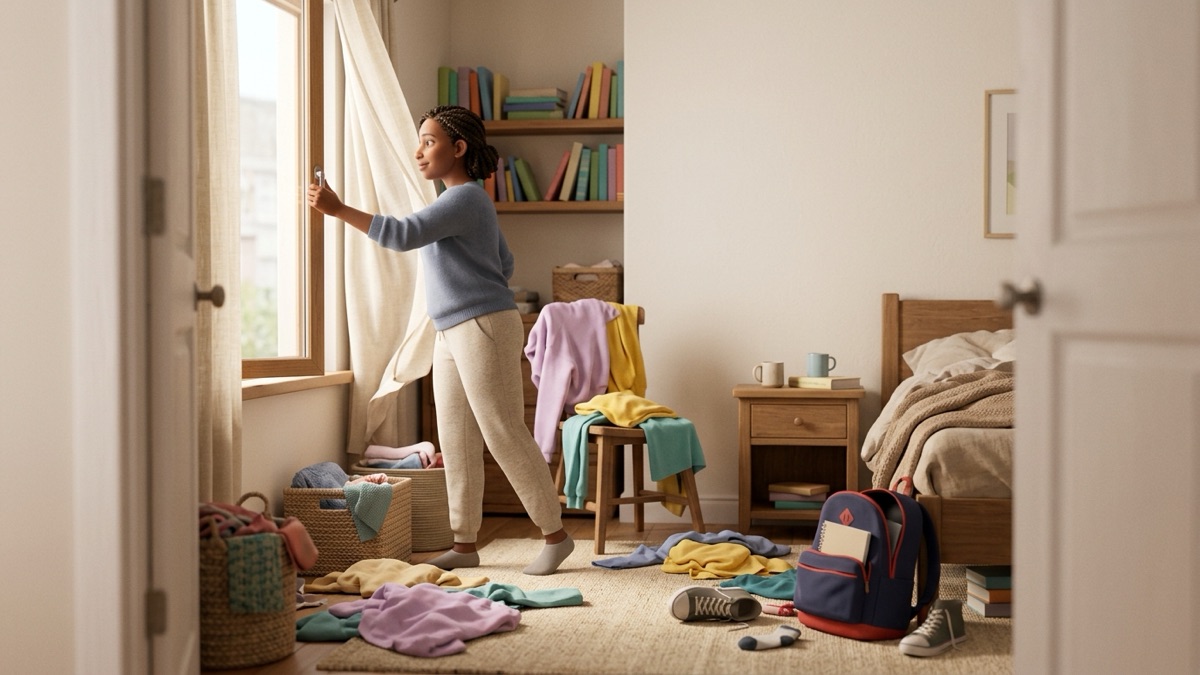
You open the door, look at the floor, and quietly close the door again. Fair enough. When everything in a room needs something, nothing looks like the first step, so here is the first step, and the seven after it, in the order that changes the room fastest.
Quick answer
Open a window, then work in this order: trash, dishes, all the clothes into one pile, things that have a home, things that do not, surfaces, and finally the floor. Each step makes the next one easier and the room visibly better. Set a timer for 5 to 15 minutes and stop when it ends.
Key takeaways
- A really messy room is a to-do list, not a verdict on you. It needs a sequence, not willpower.
- Do the no-decision jobs first (trash, dishes, laundry), and save the thinking jobs for when the room already looks better.
- One pile beats ten sorted piles. All the clothes go into one basket on the first pass.
- Things without a home go into one box so they stop blocking you. You decide about them later.
- Five minutes counts. The order is built so you can stop after any step and the room is still better than it was.
Why is a really messy room so hard to start?
Because a messy room is not one job. It is a few hundred tiny decisions wearing a trench coat. Is this cup done? Is this shirt clean? Where does this cable even go? Your brain tries to hold all of them at once, and the most reasonable response to a few hundred decisions is to go and do something else.
If you have ADHD, or think you might, this may sound very familiar. CHADD (Children and Adults with Attention-Deficit/Hyperactivity Disorder) calls getting and staying organized "a real challenge" for people with ADHD and notes that many adults have trouble with clutter at home and at work and end up feeling overwhelmed or stuck. That is a description of a common struggle, not a character flaw.
There is also a small body of research on how our homes feel to us. In one study, 60 spouses from dual-income families gave self-guided tours of their homes. Wives whose descriptions leaned on clutter and unfinished projects had flatter daily cortisol patterns and more depressed mood over the day (Saxbe and Repetti, 2010). It was small, it was correlational, and it measured how people talked about their homes rather than how much stuff was in them, so it cannot say clutter causes anything. What it does hint at is that the feeling your room gives you is real and worth taking seriously. That is a reason to be kind to yourself, not a reason to panic.
The fix for too many decisions is a fixed order. When you already know what comes next, you do not have to decide. You just do the next step.
What do you need before you start?
Two minutes of gathering, no shopping. Grab:
- A trash bag, plus a second one if you recycle.
- A laundry basket. No basket? A pillowcase or a big bag works.
- A "goes somewhere else" basket for things that live in another room.
- A "not sure" box for things with no home yet.
- A timer, and something to listen to.
Those last two containers come straight from CHADD's own tip for sorting: three boxes marked "keep here," "goes somewhere else" and "not sure." It works because it turns every item into a quick drop instead of a debate.
Tip
Put the trash bag by the door, not in the middle of the room. Every trip to the bag is also a step toward the exit, and the full bag is already where it needs to leave from.
In what order should you clean a really messy room?
This order goes from no-decision jobs to thinking jobs, and from big visible change to small detail. Follow it even if another spot is bugging you more. The order is doing the deciding for you.
1. Open a window (1 minute)
Open the curtains and a window, even for five minutes on a cold day. Fresh air and daylight change how the room feels before you have moved a thing, and the simple act of doing something is the start line.
2. Trash first
Trash is the easiest decision in the room: it is trash. Wrappers, bottles, receipts, empty boxes, tissues. Walk the room once with the bag and only pick up trash. If counting helps, aim for 20 pieces and then see how you feel.
Old food goes in the bag too. CDC advice is never to leave perishable food out for more than 2 hours (1 hour if it has been above 90 F), so last night's takeout goes in the trash, not back in the fridge.
Heads up
If you find anything broken or sharp (a glass, a razor, a snapped hanger), pick it up with a dustpan or gloves, not bare hands, and wrap it before it goes in the bag.
3. Dishes out
Every cup, mug, plate, bowl and fork leaves the room. You do not have to wash them yet. Stack them by the door and carry them to the kitchen in one or two trips. Anything crusty gets a soak with hot water and a little dish soap and then you walk away from it. Soaking is doing the work for you.
4. All the clothes into one pile
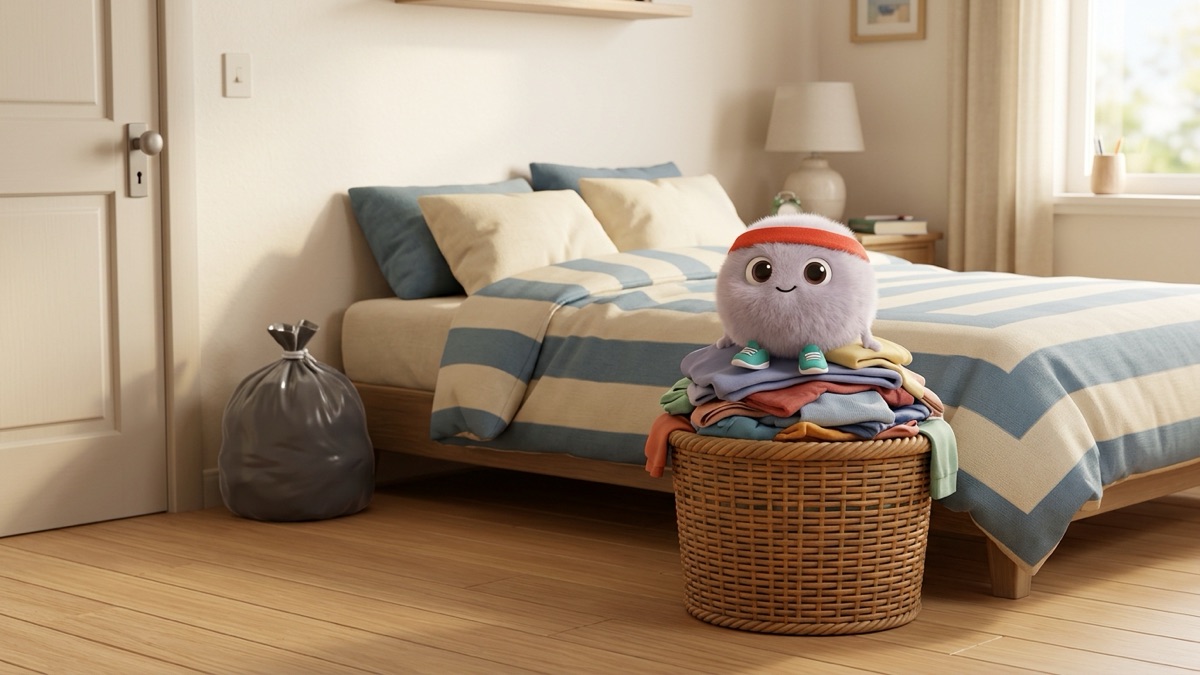
Every piece of clothing on the floor, the chair and the bed goes into the basket. Clean, dirty, maybe: all of it. Do not sort. Sorting is where messy-room cleans go to stall, and washing a clean shirt a second time costs far less than twenty minutes of sniff tests.
This is the step where the floor suddenly shows up. Enjoy it for a second.
5. Things that have a home
Now put back everything that already has a spot. Books on the shelf, shoes in pairs by the closet, chargers in their drawer, bag on its hook. The rule: if you know where it goes within about 3 seconds, it goes there. If you have to think, it waits for the next step.
6. Things that do not have a home
Everything left over goes into the "not sure" box, and anything that belongs in another room goes into the "goes somewhere else" basket. Do not solve the riddle of where the hole punch should live right now. You are clearing space, not designing a storage system.
When you do sit down with that box later, our guide on how to start decluttering when you feel overwhelmed walks through it gently, and the free declutter decision helper asks a few yes or no questions for any single item you are stuck on.
7. Surfaces
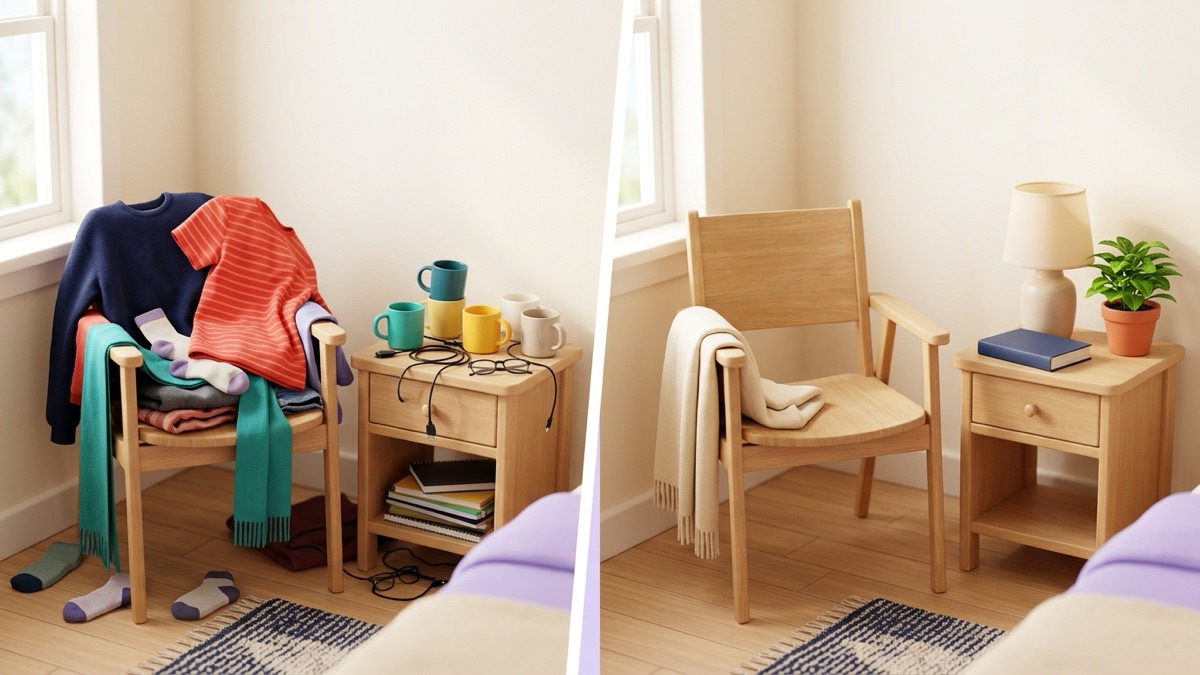
With most of the stuff gone, the nightstand, desk and dresser are mostly bare. Wipe them with a damp cloth, or one all-purpose cleaner used the way its label says. Then put back only what you use most. Three things on a nightstand is plenty.
8. The floor
The floor is last because now you can actually reach it. Vacuum or sweep the open middle of the room and the path from the door. Under the bed and the corners can wait for another day.
How long does it take? The 5, 15 and 45 minute versions
You do not need a free afternoon. Pick the version that fits the time and energy you actually have today.
| Time you have | What to do | What you will notice | Good stopping point |
|---|---|---|---|
| 5 minutes | Open a window, fill one trash bag, carry the cups out | Fewer wrappers, a clear path | After the cups leave |
| 15 minutes | Steps 1 to 4: window, trash, dishes, every piece of clothing into one pile | The floor starts showing | When the basket is full |
| 45 minutes | All 8 steps, as three 15 minute sprints with a 5 minute break between each | A room that works again | After the floor |
If the 45 minute version sounds like too much today, do the 15 minute one and stop. Tomorrow's 15 minutes starts from a better room.
Try it
Open the free cleaning sprint timer and pick "I don't know where to start." It hands you one tiny task at a time, like "Throw away 3 pieces of trash," "Carry every cup and mug to the kitchen" and "Gather all the loose laundry into one pile." Press Done or Skip, and Zip, our dust bunny body double, cleans alongside you until the timer ends.
What if you run out of energy halfway?
Then you stop, and it still counts. Every step in the order above leaves the room better than before it, so there is no half-finished state that is worse than where you began. You do not owe the room a finish.
A few ways to make stopping easier on future you:
- Stop before you hate it. Ending while you still feel okay makes the next start easier.
- Leave the next step obvious. Put the laundry basket in front of the door or leave the trash bag open. Tomorrow's start is already set up.
- Sit in the cleared spot for a minute. You made that space. Let it register.
CHADD suggests a trick called "Just for 15 minutes": set a timer, focus on one thing, and when it rings, decide whether to go another 15. The decision to continue comes after the work, not before it, which is exactly when it is easiest to make.
How do you clean a messy room over several days?
If the room has been building up for weeks, give it a few days too. One way to split it:
- Day 1: steps 1 to 4 (window, trash, dishes, laundry). The room looks different already.
- Day 2: steps 5 and 6 (things with a home, then the boxes).
- Day 3: steps 7 and 8 (surfaces and the floor), plus one load of laundry.
After that, CHADD's suggestion of a 10 minute pickup each night keeps the ground you gained. Even 5 minutes before bed works: clothes in the basket, cups out, surfaces cleared. The last guide in the list below turns that into seven tiny habits.
Which messy room guide do you need next?
This page is the starting point. The rest of our messy room guides each cover one situation:
- You want exact steps for your bedroom: how to clean your room, step by step, in three 10 minute sprints with a clear finish line for each.
- It is not one room, it is the whole home: when your home feels beyond help has a gentle first hour and a plan for the week after.
- Someone is coming over soon: emergency cleaning is a minute-by-minute 30 minute plan for the parts guests actually see.
- You cleaned it and want it to stay that way: start with the nightly reset in how to keep your room clean.
When is it more than a messy room?
Most messy rooms are just messy rooms. Sometimes, though, the room is a sign that life itself has been heavy for a while.
- If you have felt low for a long stretch. NIMH lists common signs of depression such as a persistent sad, anxious or "empty" mood, loss of interest in things you used to enjoy, and fatigue or feeling slowed down. If that has been most of the day, nearly every day, for two weeks or more, please talk to a health care provider. Depression can be treated, and you deserve support. Our guide to depression cleaning has gentler ways to start on hard days.
- If letting go of things causes real distress. The American Psychiatric Association describes hoarding disorder as persistent difficulty parting with possessions because of a perceived need to save them, where discarding causes distress and the clutter disrupts the use of living spaces. That is a mental health condition, not a messy room, and a cleaning plan is not the right help for it. A mental health professional can help, and there is no shame in asking.
If you ever feel like you might hurt yourself, call or text 988 in the US to reach the 988 Suicide and Crisis Lifeline, any time of day.
The short version
Open a window. Trash, dishes, clothes into one pile. Things with a home, then things without one. Surfaces, then floor. Use a timer, take breaks, and stop whenever you need to, because every step you finish is a step the room keeps. The TidySprint app, coming soon, will turn a photo of a messy room into a short plan of tiny tasks like these. Until then, the first step is the same as always: open the window.
TidySprint guides share practical cleaning and routine ideas. They are not medical advice, diagnosis or treatment. If ADHD, depression or anything else is making daily life hard, please talk to a clinician. Using a strong cleaner? Open a window, follow the label, and never mix bleach with ammonia, vinegar or other cleaners.
Questions people ask
Where do I start when my room is really messy?
Open a window, then pick up the trash. Trash needs no decisions and makes a visible difference fast, which makes the next step (dishes, then laundry) feel easier.
How long does it take to clean a really messy room?
Often about 45 minutes of actual cleaning, or a few short sessions over several days. Three 15 minute sprints with short breaks are easier to finish than one long push.
Should I sort clean and dirty laundry while I clean my room?
Not on the first pass. Put every piece of clothing into one basket or one pile so the floor clears, then sort it when you do the wash.
What do I do with things that do not have a place?
Put them all in one box so they stop blocking the rest of the room, then decide later, one item at a time. The free declutter decision helper on TidySprint can help with the tricky ones.
Does a messy room mean something is wrong with me?
No. Messy rooms happen in busy, tired, stressful and ordinary lives. If daily tasks have felt very hard for weeks, or you have felt low most days, a health care provider or mental health professional can help.
Where these facts come from
- CHADD: Organizing the Home and Office Space: chadd.org/for-adults/organizing-the-home-and-office-space/
- CDC: Preventing Food Poisoning (reviewed November 24, 2025): www.cdc.gov/food-safety/prevention/index.html
- Saxbe and Repetti 2010, No Place Like Home, Personality and Social Psychology Bulletin (Crossref record): api.crossref.org/works/10.1177/0146167209352864
- NIMH: Depression: www.nimh.nih.gov/health/publications/depression
- American Psychiatric Association: What Is Hoarding Disorder?: www.psychiatry.org/patients-families/hoarding-disorder/what-is-hoarding-disorder
- 988 Suicide and Crisis Lifeline: 988lifeline.org/